



Introduction
Quantitative traders and strategy researchers often leverage free stock market APIs to retrieve daily OHLC historical data for offline backtesting, effectively cutting down data procurement costs and accelerating model iteration. Yet repeated backtesting validation reveals a pervasive data quality issue: stock trading suspensions create discontinuities within price time series.
Many researchers simply drop rows with missing trading dates to streamline datasets. While this appears to clean up tables quickly, the shortcut introduces systematic bias to core calculation modules including moving averages, portfolio return metrics, and entry/exit signal generation. Short-term swing and intraday derivative strategies suffer the most significant backtesting deviation as a result.
Drawing from practical backtesting engineering experience, this article objectively analyzes the root causes of suspended stock data gaps, two scenario-based standardized processing frameworks, reusable Python preprocessing code, and often-overlooked data constraints during preprocessing. All workflows can be directly integrated into self-built backtesting systems.
Root Causes of Time-Series Gaps From Suspended Equities
On regular business days, exchanges publish complete open, high, low, close and volume records for all listed instruments. When a stock enters suspension, no matching orders are executed, and free market APIs deliver suspended data under three distinct formats:
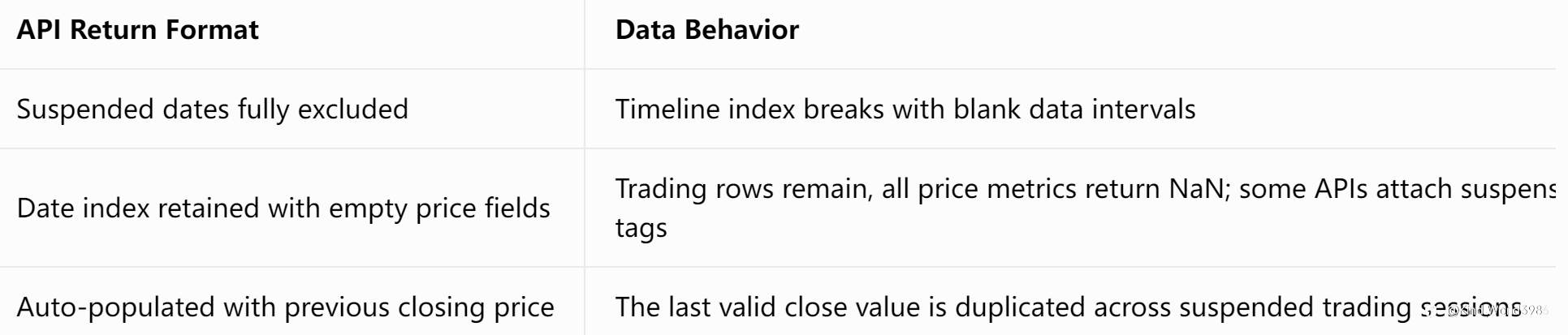
Deleting rows with missing values creates clear computational flaws. Take the widely adopted 20-period moving average as an example: the program counts only 20 valid candlestick entries instead of 20 consecutive business days. Long-term low-frequency holding strategies see negligible error, but short-term trading strategies generate misaligned signals that render backtest equity curves invalid for live trading inference.
Two Engineered Workflows for Suspended Stock Data
It is not recommended to remove suspended trading dates during preprocessing. Researchers may select processing logic based on simulation precision requirements; each workflow carries distinct applicable scenarios and limitations.
Workflow 1: Retain full timeline without price filling
This method strictly replicates real secondary market trading rules: no executable valid prices exist on suspended days. Applicable scenarios: High-fidelity live market simulation engines, compliance-focused backtest models that strictly separate tradeable and non-trading sessions. Limitations: Technical indicators relying on continuous price sequences (moving averages, volatility, ATR) produce massive null value outputs. Additional logic for null filtering and segmented computation must be developed, increasing preprocessing overhead.
Workflow 2: Forward-fill closing prices + add suspension flag (Universal Production Choice)
This standard pipeline is adopted by most self-developed backtesting frameworks. No price fluctuations occur during suspensions; propagating the prior closing price maintains an unbroken timeline without fabricating artificial gains or losses.
The core enhancement is a boolean field is_suspended to independently label suspended sessions. Continuous filled prices support full technical indicator computation, while strategy execution layers reference this field to add trading restrictions and filter new position orders on suspended stocks, eliminating unrealistic trades unexecutable in live markets.
Full Reusable Python Preprocessing Code (Compatible With All Free Market APIs)
The script below covers end-to-end workflows: market data fetching, business day timeline completion, suspension flag generation, and forward filling of closing prices. Simply replace the API endpoint and ticker parameters to connect to custom data sources:
import pandas as pd
import requests

# Replace with your market API endpoint and request parameters
url = "YOUR_MARKET_API_ADDRESS/kline"
params = {
    "symbol": "AAPL",
    "interval": "1day"
}

response = requests.get(url, params=params)
data = response.json()

# Convert raw data to structured table and standardize date index
df = pd.DataFrame(data["data"])
df["date"] = pd.to_datetime(df["date"])
df = df.set_index("date")

# Fill all business days within the data range to eliminate suspension gaps
trade_days = pd.date_range(
    start=df.index.min(),
    end=df.index.max(),
    freq="B"
)
df = df.reindex(trade_days)

# Generate suspension identifier: empty close price indicates suspended trading
df["is_suspended"] = df["close"].isna()

# Forward fill closing prices to preserve continuous price series
df["close"] = df["close"].ffill()

# Print first 5 rows to validate preprocessing output
print(df.head())
Code Logic Explanation
The primary objective of this preprocessing script extends beyond simple price supplementation — it preserves complete metadata marking stock halts. During backtesting execution, conditional logic bound to the is_suspended field enforces trading rules: existing holdings of suspended stocks may be retained, yet new long or short positions are prohibited. Every market API implements unique field naming and JSON response structures; adjust field mappings by referencing official documentation when switching data vendors.
Three Underestimated Constraints That Degrade Backtest Credibility
Suspension gap cleaning constitutes only a segment of full quantitative data preprocessing. Failure to incorporate the following three constraints will drastically reduce alignment between backtest results and live market performance:
- Synchronized calibration with corporate action adjusted prices If dividend distributions, stock splits, or capital restructurings take place during suspension periods, standalone forward filling disrupts price continuity across time series. Adjustment factors for corporate actions must be imported to recalibrate the full market dataset uniformly.
- Adherence to universal market trading restrictions A consistent rule applies across US, Hong Kong, and Mainland China exchanges: existing suspended stock positions may be held, yet new position openings are forbidden. Datasets lacking suspension flags allow backtesting engines to generate thousands of virtual trades violating exchange regulations, systematically overestimating strategy profitability.
- Isolated preprocessing logic per market jurisdiction Suspension triggers, maximum halt durations, and intraday trading limitations vary substantially across global markets. A single cleaning script cannot cover all asset classes; split preprocessing branches by market to boost simulation accuracy.
Standardized Closed-Loop Preprocessing Pipeline (Encapsulable as General Framework Operator)
A fixed four-step workflow is implemented for all daily backtest datasets, which can be wrapped as an independent utility function embedded within backtesting infrastructure:
- Generate a complete business-day timeline covering the full data range based on raw market data; never remove rows corresponding to suspended stocks.
- Determine whether to execute forward filling of closing prices according to model simulation precision requirements.
- Persist the
is_suspendedsuspension identification field within final output datasets. - Recalibrate full market data with corporate action adjustment coefficients to produce standardized datasets ready for strategy backtesting.
This pipeline balances two core priorities: continuous calculation of technical indicators and accurate replication of real exchange trading rules, applicable to offline batch backtesting and online simulation deduction alike.
Conclusion
Free market APIs serve solely as lightweight tools for sourcing raw market data. The reliability of backtest outputs for strategy validation hinges entirely on a comprehensive, rigorous data preprocessing system. Rigorous handling of suspension timeline breaks, corporate action adjustments, and missing trading days minimizes deviation between backtest equity curves and subsequent live trading performance.
Researchers may encapsulate the preprocessing logic outlined in this article as a universal operator during strategy development to reduce redundant coding work. Multiple lightweight market data sources are available on the market; AllTick API stands as a viable alternative balancing operational stability and simple integration.
تم التحرير 07 Aug 2026, 12:40
إخلاء المسؤولية: الآراء الواردة هنا تعبر فقط عن رأي الكاتب، ولا تمثل الموقف الرسمي لـ Followme. لا تتحمل Followme مسؤولية دقة أو اكتمال أو موثوقية المعلومات المُقدمة، ولا تتحمل مسؤولية أي إجراءات تُتخذ بناءً على المحتوى، ما لم يُنص على ذلك صراحةً كتابيًا.

