US stock funds extended their winning streak with a second consecutive week of capital inflows through 30 September, as cooling inflation and strong AI momentum successfully calmed investor fears over rising Treasury yields.
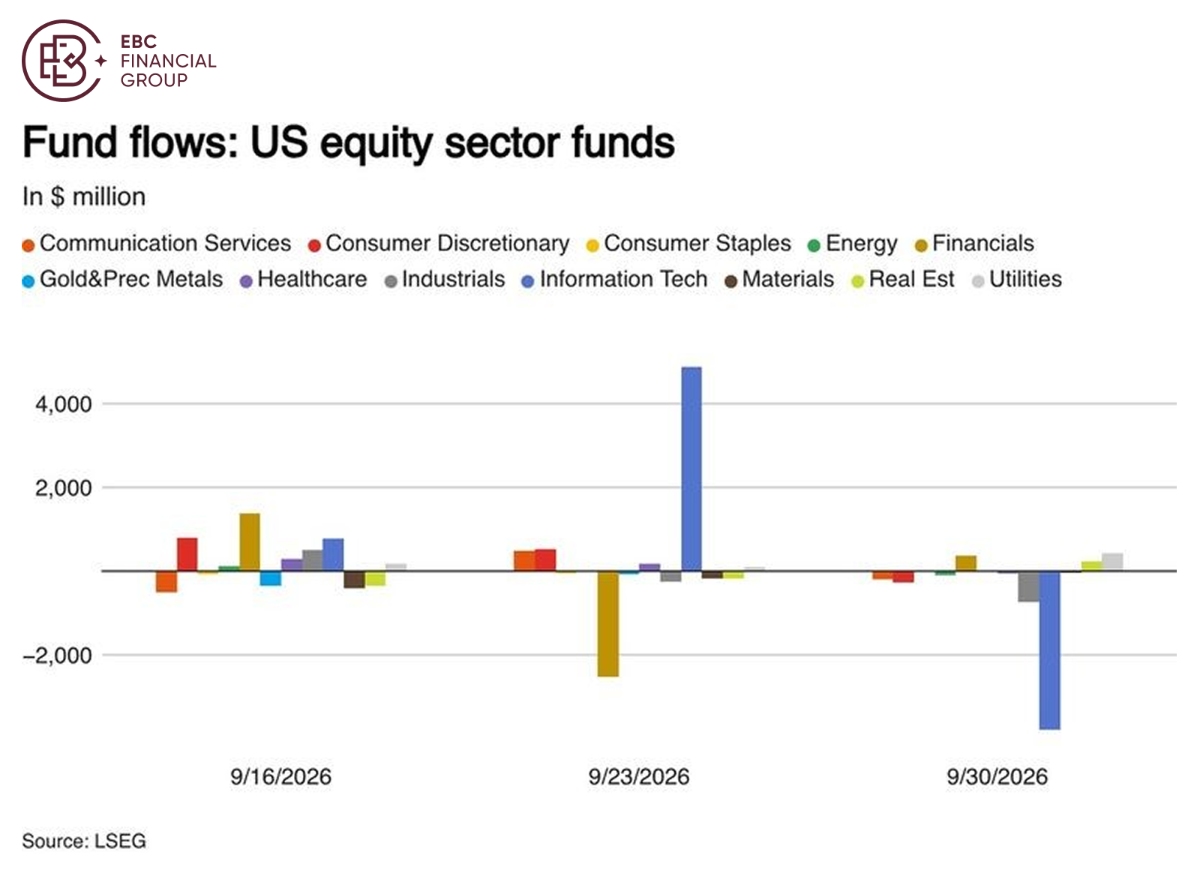
US large-cap equity funds attracted $19.33 billion, their second-largest weekly inflow in the past quarter. Meanwhile, sectoral equity funds saw outflows, led by technology and industrials.
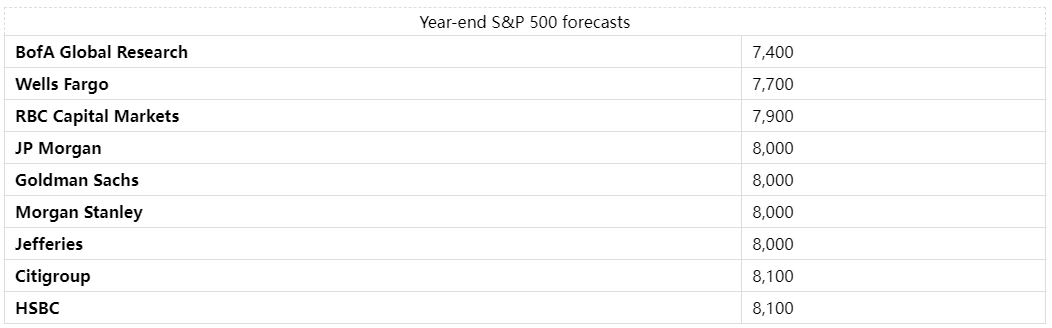
Driven by the AI infrastructure boom, S&P 500 (SPXUSD) Q3 earnings are projected to climb 27% year-over-year, according to Goldman Sachs. But the bulk of the growth is again set to come from Big Tech.
The bank estimates Micron and Nvidia are expected to account for more than one-third of the total earnings expansion, fuelling concerns that the ongoing rally may hardly broaden out.
Market breadth has collapsed to levels not seen since the dot-com bubble as capital remains heavily concentrated in a select group of AI-related stocks.
Still, all 11 S&P 500 sectors are expected to report earnings growth, according to FactSet. Among them, the energy companies are expected to post soaring profits amid the Middle East flare-up.
The benchmark index's 12-month forward P/E ratio has compressed to approximately 19 times, a significant decrease from the 22.2 times recorded in early January, opening the door to further gains.
Unlike the S&P 500, which is heavily weighted toward AI-driven tech stocks, the Russell 2000 Index (RUTUSD) focuses more on economically sensitive sectors such as financials and industrials.
But the index underperformed moderately this year, as its gap shrunk to an anomalous degree amid the tightening cycle. The valuation disparity between the two reached its highest level in decades earlier this year.
Structural US economic indicators have remained incredibly resilient. That benefits small caps which have capitalized heavily on domestic capital expenditures and national infrastructure.
Iron nerves
As the benchmark 10-year Treasury yield holds firmly above 5%, the federal government's fiscal burden continues to rise. Net interest expenses reached approximately $1.05 trillion during the first 11 months of this fiscal year.
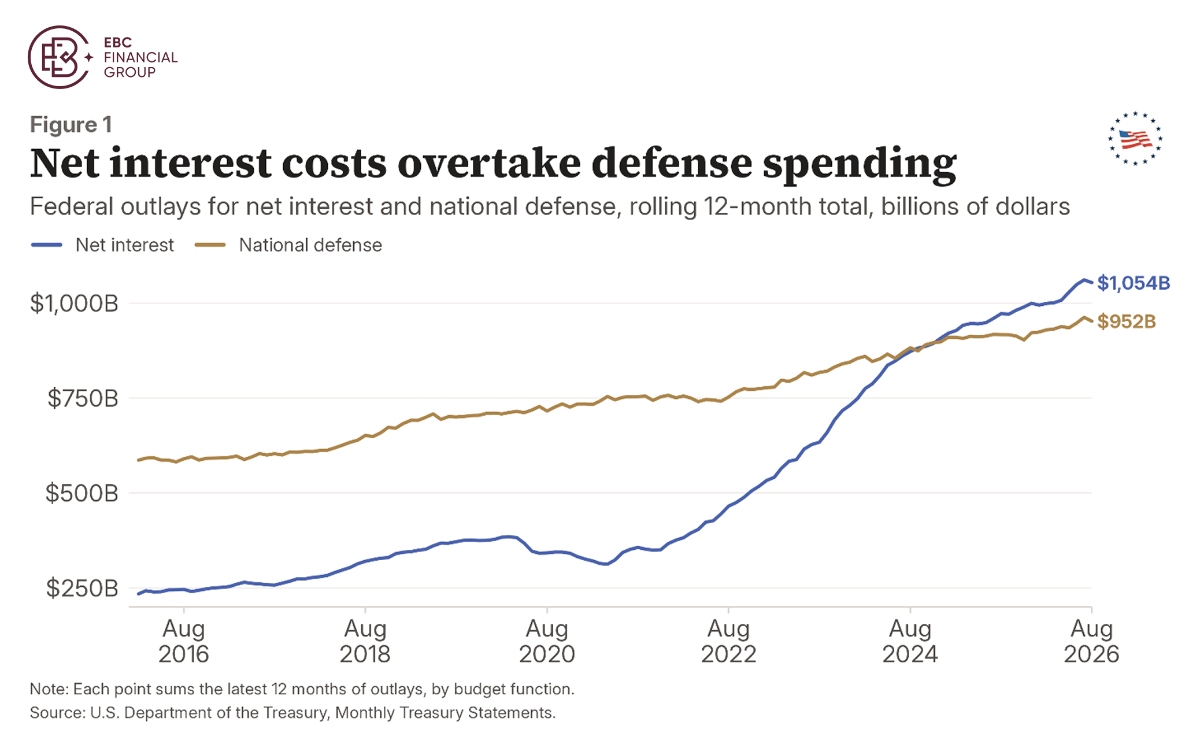
Maya MacGuineas, president of the CRFB, cautioned that escalating borrowing costs could trigger a self-reinforcing cycle, as rising interest expenses compel the US government to incur even more debt.
PIMCO's Dan Ivascyn stated that a surge in 10-year Treasury yields to 5.5% or higher would likely induce substantial weakness in both credit and equity risk markets.
But he noted that elevated yields will ultimately encourage investors to reallocate more capital into Treasuries to secure strong returns, acting as a natural cap on further yield increases.
With US government debt lasting about 5.9 years on average, higher borrowing costs phase in slowly as old bonds expire and new ones are issued at current rates.
UBS strategists recently observed that rising yields pose a greater risk to equities only when economic growth begins to weaken, which is currently mitigated by the ongoing, robust AI infrastructure build-out in the US.
"We forecast S&P 500 earnings growth of 25% this year and 14% in 2027, which should help equities absorb moderately higher interest rates," the bank's chief investment officer said.
K-shaped trap
Americans have been relentlessly spending their paychecks despite rising prices. However, with borrowing costs, it is highly uncertain whether they will finally tighten the purse strings.
Apparent growth in retail sales and consumer spending may be misleading. These metrics are not inflation-adjusted, Americans are paying more for fewer goods, leaving corporate earnings weak.
Last month Walmart (WMT.N) reported its slowest comparable quarterly sales growth in 6 years and warned shoppers were likely being squeezed by fuel costs; Nike (NKE.N) is embarking on a turnaround programme designed to reverse sales declines.
Wall Street sentiment is largely bearish on consumer stocks. For the first time since the end of 2024, investors expect negative earnings growth for the sectors, according to data compiled by Bloomberg Intelligence.
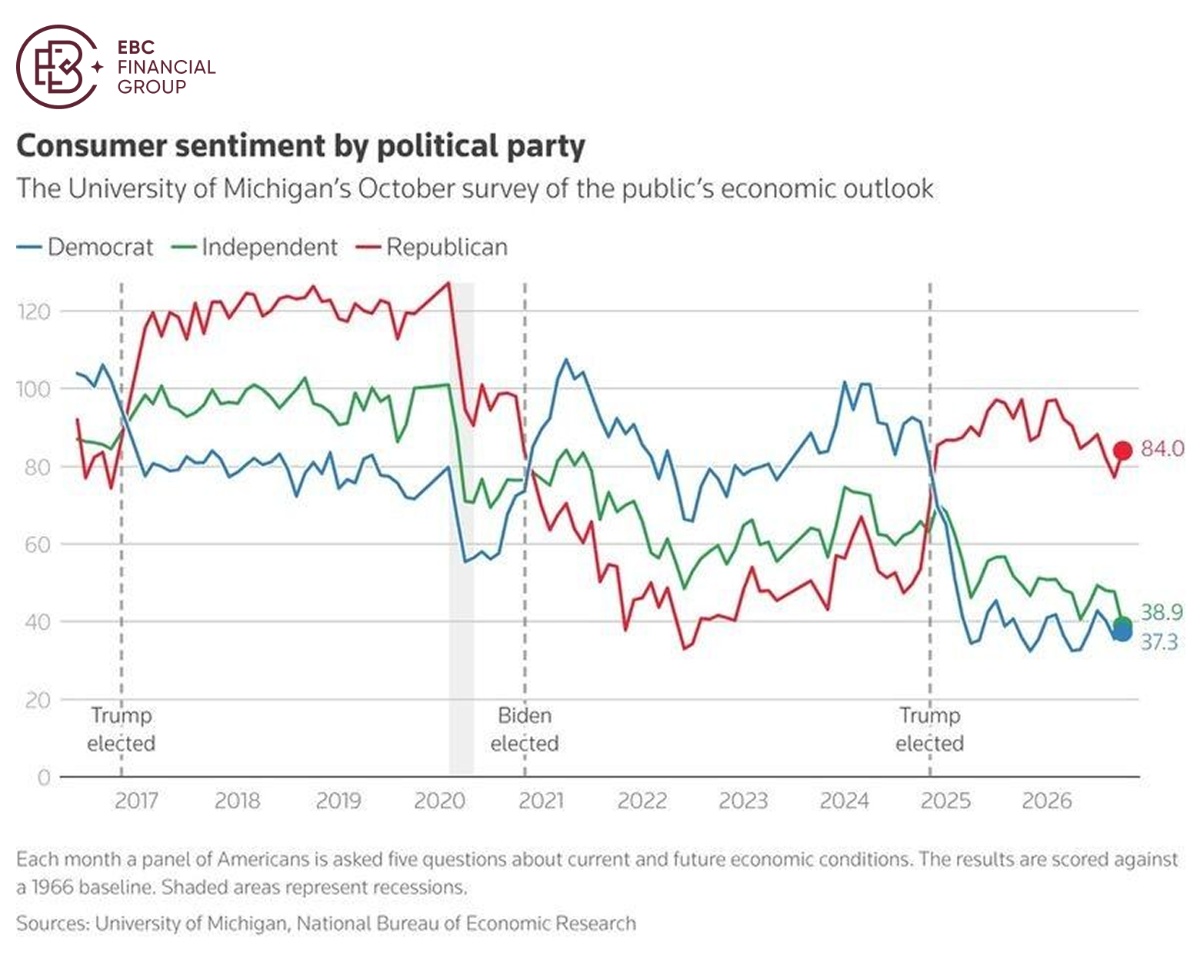
US consumer sentiment slumped further in early October as the rising cost of living, according to the University of Michigan. Higher income consumers were more likely to maintain spending than their lower-income counterparts.
In September, the Consumer Discretionary Select Sector SPDR ETF (XLY.P) recorded $638 million in net outflows, its sharpest monthly drop since January. That adds more pressures to the battered fund.
It has significantly underperformed the Consumer Staples Select Sector SPDR ETF (XLP.P) up until now in 20226. Looking ahead, the K-shaped trap remains an encumbrance to durable goods purchase.
EBC Financial Group Disclaimer: This material is for general information purposes only and is not intended as (and should not be considered to be) financial, investment or other advice on which reliance should be placed. No opinion given in the material constitutes a recommendation by EBC Global Financial Collaboration or the author that any particular investment, security, transaction or investment strategy is suitable for any specific person.
إخلاء المسؤولية: الآراء الواردة هنا تعبر فقط عن رأي الكاتب، ولا تمثل الموقف الرسمي لـ Followme. لا تتحمل Followme مسؤولية دقة أو اكتمال أو موثوقية المعلومات المُقدمة، ولا تتحمل مسؤولية أي إجراءات تُتخذ بناءً على المحتوى، ما لم يُنص على ذلك صراحةً كتابيًا.