



MARKET REVIEW FOREX FED
Dollar Caught Between Warsh's Hawkish Pivot And Iran's Renewed Fire
A hawkish Fed chair, a record-breaking debt bill, and a shooting war in the Gulf are all pulling on the dollar at the same time and none of them agree on direction.
Followme News Desk | September 1, 2026
Three separate stories landed on Forex desks within 48 hours of each other, and none of them are small. That's the setup traders are waking up to on the first trading day of September.
Start with the Fed. Chair Kevin Warsh went to Jackson Hole on Friday and did something markets weren't fully braced for he sounded like a hawk. He told the room the Fed still has "work to do" if inflation doesn't retreat, and said he'd be "hard pressed to describe broad financial conditions as restrictive" right now. That single line was enough to flip the rates market. Odds of a hike at the September 15–16 FOMC meeting jumped from roughly 30% before the speech to as high as 60-66% afterward.
Here's the odd part: the dollar barely moved. Gold and Treasury yields did far more of the reacting than the greenback did. EUR/USD spiked and then settled right back near 1.1600, and USD/JPY reset to levels seen before Warsh even opened his mouth. Part of the reason: not everyone at the top is on board. The Treasury Secretary has openly pushed back on the hawkish case, arguing the economy is dealing with a supply shock, and that you don't typically raise rates into a supply shock unless second- or third-order effects show up. That's a real Fed-versus-Treasury split, and it's exactly the kind of tension that keeps traders from fully committing to the hawkish read. There's also a case being made that Warsh's comments were only marginally more hawkish than usual, and that there was no consensus to raise rates even back at the July meeting.
Then there's Iran, and this is the story that actually moved commodities overnight. The US and Iran are six months into open conflict, and the ceasefire-that-wasn't broke down again over the weekend. The US struck Iranian rocket launchers on Larak Island late Sunday, saying Tehran was preparing to mine the Strait of Hormuz, and Iran hit back with missiles aimed at US bases in Jordan and a drone toward the UAE. Trump's response was blunt: "We're going to hit them hard... there will be a response." Jordan said it intercepted eight missiles. It's the first direct exchange of fire between the two sides in over a month, and it hasn't stopped there. A tanker took three projectile hits overnight while exiting Hormuz near Khasab, Oman, the fourth such incident in the area in a matter of days.
Oil is doing exactly what you'd expect. Brent has cleared $90 and WTI is trading above $86, up more than 3% on the day, and the risk premium isn't going anywhere while Hormuz stays effectively shut to a meaningful chunk of global tanker traffic.
Layer the fiscal picture on top and the dollar's dilemma gets sharper. US annual interest expense has hit a record 18.5% of federal government revenue above the previous record of 18.4% set back in 1991 with the government now paying out roughly $1.25 trillion a year just to service the debt. That's more than four times what it was paying in 1991, on debt that just crossed $40 trillion. It's also the backdrop that makes Warsh's hawkishness politically loaded: the Treasury recently doubled its long-term bond buybacks and reportedly floated using its General Account to prop up the bond market, feeding "fiscal dominance" fears that the Fed's independence is being quietly leaned on. Warsh's Jackson Hole tone was, in that light, as much a statement about who's actually in charge of policy as it was about inflation.
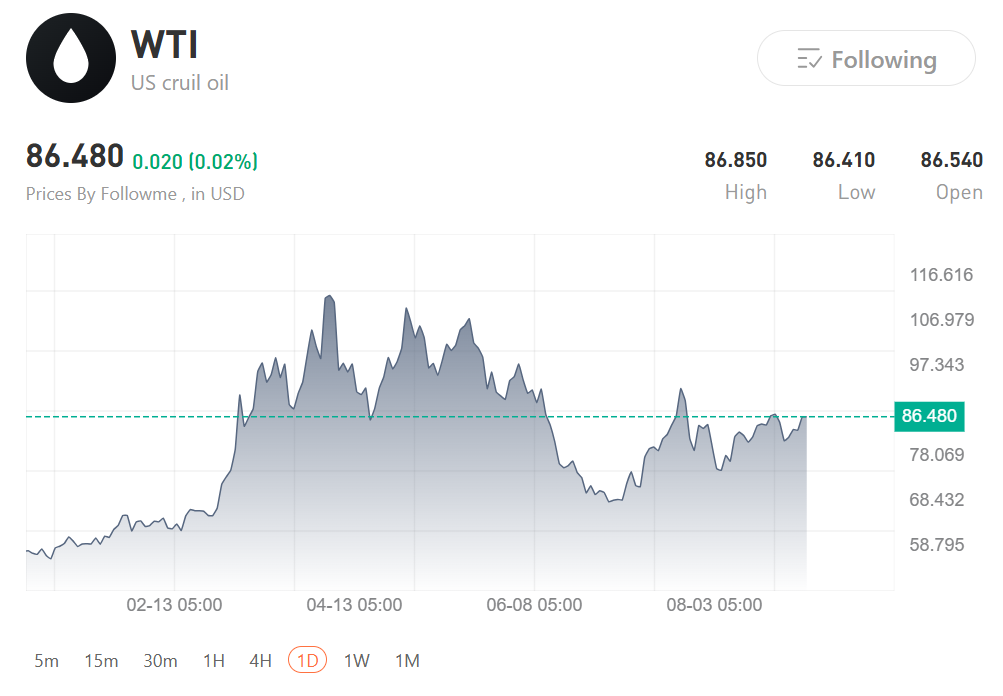
WTI $86.48 as of Sep 1, 2026 - View Live Chart →
The Facts
- Fed pricing: Warsh's Jackson Hole speech Friday pushed September rate-hike odds from roughly 30% to as high as 60–66%. The FOMC meets September 15–16.
- Muted FX reaction: EUR/USD settled back near 1.1600 and USD/JPY reset near pre-speech levels despite the 2-year Treasury yield jumping more than 10bp intraday.
- Treasury pushback: The Treasury Secretary publicly disagrees with the hawkish case, calling current inflation a "supply shock" that doesn't normally justify hiking.
- Gold pulling back: Gold is down roughly 6% from last week's high near $4,700, trading near $4,410, a level that lines up with the 100-day moving average and the 38.2% Fibonacci retracement of the summer rally. A confirmed lower break exposes $4,320 and $4,230. A bounce could revive the dollar-debasement trade.
- Iran conflict reignites: The US struck Iranian rocket launchers on Larak Island Sunday; Iran retaliated with missiles toward Jordan (eight intercepted) and a drone toward the UAE. It's the first direct fire exchange between the two sides in over a month, after six months of overall conflict.
- Fresh Hormuz incident: A tanker was struck by three unknown projectiles near Khasab, Oman. While exiting the Strait of Hormuz overnight, the fourth such strike logged into the area within days.
- Oil elevated: Brent above $90, WTI above $86 and up more than 3% on the day.
- US debt/fiscal strain: Annual interest expense of roughly $40 trillion in federal debt has hit a record 18.5% of government revenue, about $1.25 trillion a year, surpassing the prior 1991 record.
- This week's other central bank action: RBNZ expected to continue its hiking cycle Wednesday; Bank of Canada expected to hold, with core inflation at a five-year low.
What It Means
The muted dollar reaction to Warsh's hawkish turn is the tell here. If the market fully believed a September hike was coming, the dollar should be running, not consolidating. Instead, it looks like traders are pricing in the possibility while doubting the follow-through because the fiscal side of government is openly making the opposite case in public, and because a genuine rate hike would only worsen an already record-breaking interest bill on $40 trillion of debt. That's the fiscal-dominance tension in plain view: raising rates fights inflation but deepens the debt-service problem, and markets know it.
The Iran conflict complicates that picture rather than resolving it. Oil spiking on renewed fighting is inflationary that's exactly the kind of second- or third-order effect that would build the case for a hike. But it's also a classic supply shock, the type central banks have historically been reluctant to chase with tighter policy. In other words, the same headline can be read as ammunition for both the hawks and the doves depending on how the next few weeks play out, and that's likely why the dollar hasn't picked a clean direction yet.
Gold and havens are arguably telling a cleaner story than the dollar is right now. Its pullback shows the debasement trade cooling as rate-hike odds rise, but it's sitting exactly at a level where a bounce could just as easily restart that trade if the Iran situation escalates further or if Friday's job data disappoints. With a shooting war providing a standing bid under oil and a fragile hike narrative propping up the dollar, positioning on both sides of that gold level looks thin enough that the next move could be sharp.
What Traders Should Watch
EUR/USD - Price sitting near 1.1580, the line in the sand. The current pullback almost mirrors the reversal of the earlier Treasury-buyback rally. A break below 1.1580 opens the door toward 1.1450–1.1500, while a bounce keeps the broader range-bound uptrend intact.
Hormuz headlines - Further strike warnings versus any real diplomatic movement will swing the geopolitical premium sitting under both oil and the dollar simultaneously.
September hike odds into NFP and CPI - Whether the roughly 60% pricing for a September hike holds or fades as Friday's jobs report and the next CPI print land will be the real signal on whether Warsh's rhetoric turns into action.
RBNZ and BoC decisions Wednesday - A further RBNZ hike versus a BoC hold is a setup worth watching in AUD/NZD and USD/CAD.
US fiscal-dominance chatter - Any sign of further Treasury intervention in the bond market beyond the recent buyback increase would reinforce doubts about how independently the Fed can actually act in September.
USD/JPY - Trading near 160, with BoJ intervention risk building. Japan reportedly spent close to JPY 15 trillion defending the yen this past month. Watch for fresh intervention headlines or a BoJ hike signal.
XAU/USD - Trading near $4,410, the key technical confluence right now. A clean break lower exposes $4,320 and $4,230. A bounce here could reignite the debasement trade fast.
The Bottom Line Warsh gave the hawks a headline, but the Treasury Secretary and the bond market aren't fully buying it yet, and a debt bill this size makes a real hike a harder sell than the rate-pricing suggests. Meanwhile Iran isn't waiting around for the Fed to sort itself out. Oil has its own bid running regardless of what September brings. Until one of these two stories actually resolves, EUR/USD around 1.1580 and gold around $4,410 are the levels worth watching, and Friday's jobs report is the next real catalyst.
Follow us for daily market insights, analysis, and the tools you need to trade with confidence.
Want to stay ahead of major macro developments that move the market? 👉 Follow Followme and check out the Weekly Economic Calendar
September 1, 2026 | This report is for informational purposes only and does not constitute financial advice. © 2026 Followme News
Download Followme Application


Follow us on:


إخلاء المسؤولية: الآراء الواردة هنا تعبر فقط عن رأي الكاتب، ولا تمثل الموقف الرسمي لـ Followme. لا تتحمل Followme مسؤولية دقة أو اكتمال أو موثوقية المعلومات المُقدمة، ولا تتحمل مسؤولية أي إجراءات تُتخذ بناءً على المحتوى، ما لم يُنص على ذلك صراحةً كتابيًا.

