


During the iteration and maintenance of our forex market analysis module, I encountered a tricky and hard-to-diagnose data problem. When processing synchronous data collection for multiple forex trading pairs, all price-related fields were completely normal without abnormal fluctuations or missing values. However, the cycle K-lines generated by the system always failed to match the standard transaction cycles we expected.
At the initial troubleshooting stage, I focused entirely on price calculation logic and data aggregation rules, assuming the errors stemmed from algorithm flaws. After layered inspection of the entire data access and processing pipeline, I finally pinpointed the core cause: inconsistent timestamp standards returned by different forex API interfaces.
This is a trivial but high-impact blind spot in most forex quantitative systems. For single-currency data analysis, minor time offset errors are negligible and hardly affect data presentation. Nevertheless, when multiple currency pairs and multi-source market data are processed in parallel, scattered time deviations will gradually accumulate, triggering a series of abnormal phenomena such as misplaced K-line cycles, pseudo-data loss, and disordered market attribution. Undoubtedly, standardized timestamp processing is the core prerequisite to guarantee data accuracy in forex API integration and quantitative analysis.
Core Causes of Time Deviation in Multi-Currency Market Data
The global forex market covers multiple trading time zones worldwide, with market data sourced from diverse third-party service providers. There is no unified industry specification for interface timestamp output, resulting in three mainstream time standards in practical development: UTC universal time, trading server time, and regional local time.
Even for the same real-time market snapshot, different APIs may return completely different time values with several hours of deviation. I have sorted out the three common timestamp types and their applicable scenarios in quantitative development:
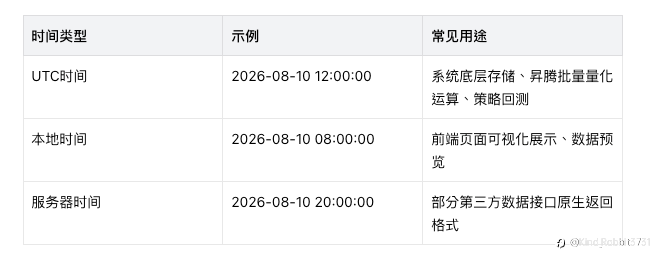
Directly invoking uncalibrated original timestamp data for K-line segmentation and cycle statistics will make multi-source market data unable to correspond to unified trading cycles. This problem is particularly prominent in short-cycle strategies such as 1-minute and 1-hour K-line analysis. Hour-level time offsets will misattribute market data to wrong trading cycles. Most seemingly strange market anomalies and data missing problems in quantitative backtesting are essentially caused by unstandardized time conversion.
Unified UTC Standard: Improve Data Stability with Pre-processing Logic
Based on years of practical project experience, I have formulated a universal development specification: all time zone calibration and format unification operations must be completed at the data entry stage, rather than being processed in subsequent data analysis and indicator calculation links. Post-processing will lead to inconsistent calibration rules across business modules, resulting in repeated bugs and increased maintenance costs.
I adopt a fixed standardized processing pipeline in all multi-currency forex projects, which is fully compatible with mainstream currency pairs such as EUR/USD and USD/JPY, ensuring consistent internal data logic:
Market Data Reception → Timestamp Field Parsing → Unified UTC Conversion → Standardized Data Storage → Adaptive Time Conversion for Display
This pre-processing mechanism completely isolates the time standard differences of external interfaces and provides unified and reliable basic data for subsequent quantitative modeling and market analysis.
In Python forex development, professional time zone libraries can achieve accurate and automatic time conversion, avoiding the defects of manual fixed offset calibration. The practical code is as follows:
'''
from datetime import datetime
import pytz

time_str = "2026-08-10 09:30:00"

eastern = pytz.timezone("US/Eastern")

local_time = datetime.strptime(
    time_str,
    "%Y-%m-%d %H:%M:%S"
)

local_time = eastern.localize(local_time)

utc_time = local_time.astimezone(
    pytz.utc
)

print("UTC时间:", utc_time)
'''
It is worth emphasizing that fixed hour offset adjustment (adding or subtracting fixed hours) is not recommended. Most global trading regions implement daylight saving and standard time switching annually, and fixed offset rules cannot adapt to dynamic time zone changes, which will cause periodic data deviations. Professional time zone libraries can automatically match official time zone rules without manual judgment, ensuring long-term and stable system operation.
Real-Time Tick Data Optimization: Complete Time Standardization in Advance
Time format problems in historical market data are latent and not easy to detect in low-frequency backtesting. However, in high-frequency real-time tick data scenarios, tiny time sorting errors will trigger a chain of failures, including K-line reconstruction errors and distorted indicator calculations, directly affecting real-time strategy execution effects.
To avoid redundant development and inconsistent rules of each business module, I uniformly integrate the time standardization logic into the data receiving layer to realize one-time global processing. In daily high-frequency market development, I use the WebSocket service of AllTick API to obtain stable real-time forex tick data streams and complete timestamp calibration synchronously.
The basic access code for real-time market subscription is as follows:
'''
import websocket
import json

def on_message(ws, message):
    data = json.loads(message)

    symbol = data.get("symbol")
    price = data.get("price")
    timestamp = data.get("timestamp")

    print(
        "AllTick API",
        symbol,
        price,
        timestamp
    )

ws = websocket.WebSocketApp(
    "wss://apis.alltick.co/websocket",
    on_message=on_message
)

ws.run_forever()
'''
In actual deployment, the field structure returned by different interfaces varies slightly. Developers can flexibly adjust timestamp parsing and conversion logic according to the actual interface return specifications to match business requirements.
Neglected Key Details of Forex Timestamp Processing
In multi-currency quantitative development, three easily overlooked details determine the overall stability and data credibility of the market system:
First, never rely on the server's local time to record market data. Server environment migration, deployment switching, and time zone configuration changes will all lead to integral offset of historical data timestamps, destroying data continuity and backtesting accuracy.
Second, match time precision with business scenarios. Second-level timestamps meet the needs of conventional market display and low-frequency analysis, while high-frequency tick quantitative strategies must rely on millisecond-level precision to ensure correct data sorting and event sequence judgment.
Third, separate calculation time and display time. The database storage and strategy calculation links uniformly adopt UTC time standards to maintain logical unity; time zone conversion for regional habits is only performed in the front-end display layer to balance data rigor and user experience.
Conclusion: Basic Timestamp Rules Determine Quantitative System Reliability
After long-term engagement in forex market system development and quantitative optimization, I have found that most complex data anomalies and strategy drift problems ultimately stem from non-standard basic data processing. Price data reflects the trend of market fluctuations, while standardized timestamps define the correct attribution of each market data point.
Although multi-source forex APIs have chaotic time standards, establishing a complete set of unified time preprocessing rules in advance can effectively eliminate hidden data dangers. It greatly improves the stability of data analysis, K-line generation and strategy backtesting.
Timestamp standardization is not a dazzling core algorithm, but a fundamental guarantee for the reliability of the entire forex data link. It is a basic skill that every forex quantitative developer and FinTech practitioner must master to achieve stable and efficient strategy iteration.

إخلاء المسؤولية: الآراء الواردة هنا تعبر فقط عن رأي الكاتب، ولا تمثل الموقف الرسمي لـ Followme. لا تتحمل Followme مسؤولية دقة أو اكتمال أو موثوقية المعلومات المُقدمة، ولا تتحمل مسؤولية أي إجراءات تُتخذ بناءً على المحتوى، ما لم يُنص على ذلك صراحةً كتابيًا.

