


· Views 47,736

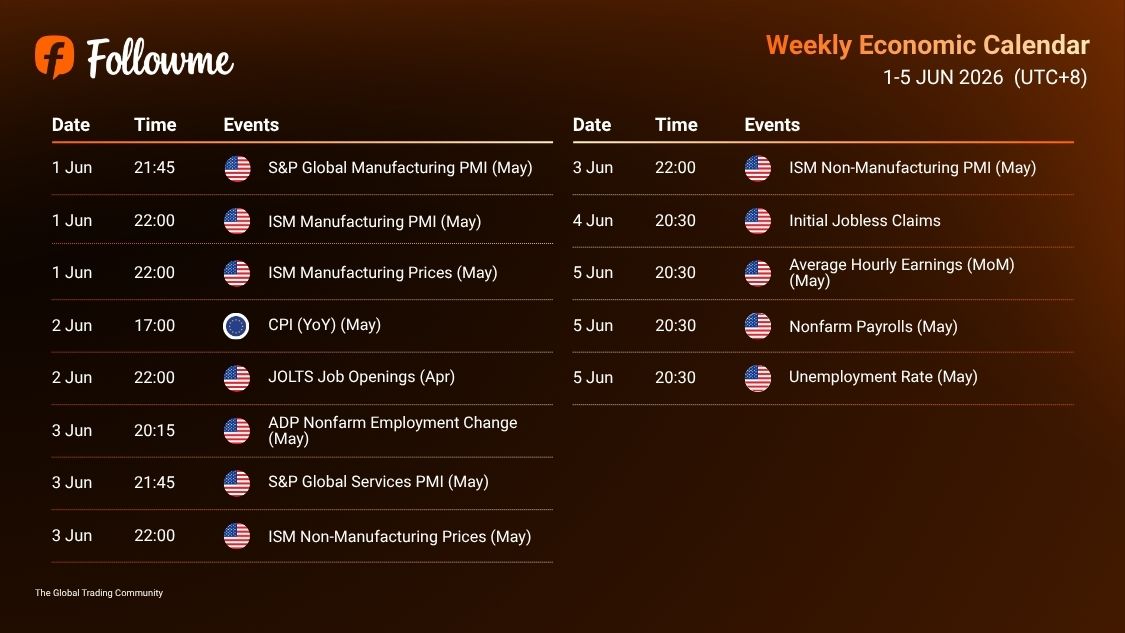
Weekly Economic Calendar: Week of 1 - 5 June, 2026 (GMT+8)
This week’s economic calendar is heavily focused on U.S. S&P Global Manufacturing PMI, ISM Manufacturing PMI and Prices Paid Index, the EU CPI, U.S. JOLTS Job Openings, U.S. ADP Nonfarm Employment Change, U.S. S&P Global Services PMI, U.S. ISM Non-Manufacturing PMI and Prices Paid Index, U.S. Initial Jobless Claims, U.S. Average Hourly Earnings, U.S. Nonfarm Payrolls and Unemployment Rate. The week begins with U.S. S&P Global Manufacturing PMI, U.S. ISM Manufacturing PMI and Prices Paid Index, before moving into the EU CPI and U.S. JOLTs Job Openings release on Tuesday.
The strongest market-moving period comes on Wednesday through Friday, where traders will face a concentrated group of U.S. high-impact events: ADP Nonfarm Employment Change, S&P Global Services PMI, ISM Non-Manufacturing PMI and Prices Paid Index and Initial Jobless Claims, followed by Average Hourly Earnings, Nonfarm Payrolls and Unemployment Rate. This creates a strong volatility setup for USD, EUR, gold, U.S. indices and global risk sentiment. U.S. Labour market data and the Unemployment Rate are highlighted as the key release of the week, with the ADP print on Wednesday serving as the first major signal of jobs-market conditions heading into Friday's report.
| Key highlights: |
🇺🇸 1 June, 21:45 - S&P Global Manufacturing PMI (May)
🇺🇸 1 June, 22:00 - ISM Manufacturing PMI (May)
🇺🇸 1 June, 22:00 - ISM Manufacturing Prices (May)
🇪🇺 2 June, 17:00 - CPI (YoY) (May)
🇺🇸 2 June, 22:00 - JOLTS Job Openings (Apr)
🇺🇸 3 June, 20:15 - ADP Nonfarm Employment Change (May)
🇺🇸 3 June, 21:45 - S&P Global Services PMI (May)
🇺🇸 3 June, 22:00 - ISM Non-Manufacturing Prices (May)
🇺🇸 3 June, 22:00 - ISM Non-Manufacturing PMI (May)
🇺🇸 4 June, 20:30 - Initial Jobless Claims
🇺🇸 5 June, 20:30 - Average Hourly Earnings (MoM) (May)
🇺🇸 5 June, 20:30 - Nonfarm Payrolls (May)
🇺🇸 5 June, 20:30 - Unemployment Rate (May)
Macro Analysis:
🇺🇸 U.S. S&P Global Manufacturing PMI and USD Sentiment
U.S. S&P Global Manufacturing PMI will be watched as an early signal of factory activity, with the forecast at 53.80%compared with the previous 54.50%. A stronger PMI alongside rising prices may support USD by signalling that factory demand is expanding while input costs remain elevated. A softer PMI or a surprise drop in prices may pressure the Dollar if traders see signs of easing industrial activity and fading inflationary pressure in the goods sector.
🇺🇸 U.S. ISM Manufacturing PMI, Prices and Cost Pressure
U.S. ISM Manufacturing PMI is forecast at 53.10%, slightly higher than the previous 52.70%, while ISM Manufacturing Prices are forecast at 80.00% compared to 78.30% previously. A stronger PMI and higher prices may support the USD by indicating expanding factory demand and elevated input costs. A weaker PMI or a drop in prices may pressure the Dollar if traders see signs of slowing industrial activity or reduced inflation in the goods sector.
🇪🇺 EU CPI and EUR Inflation Sensitivity
The Eurozone CPI is forecast at 3.00%, higher than the previous reading of 2.60%. Since CPI is closely monitored by the ECB, a hotter-than-expected reading may support EUR by reducing expectations for near-term policy easing. A softer reading may pressure EUR if traders begin pricing in a more accommodative ECB stance ahead of upcoming policy meetings.
🇺🇸 U.S. JOLTS Job Openings and Labour Demand
U.S. JOLTS Job Openings are forecast at 6.860M, slightly below the previous reading of 6.922M. Since JOLTS reflects underlying demand for labour, a stronger reading may support USD by showing that hiring intentions remain firm across the broader economy. A weaker reading may pressure the Dollar if traders interpret declining openings as an early warning of softening labour market conditions ahead of Friday's payroll report.
🇺🇸 U.S. ADP Nonfarm Employment Change and NFP Preview
U.S. ADP Nonfarm Employment Change for May is forecast at 118K, significantly higher than the previous reading of 61K. Since ADP serves as a key leading indicator ahead of Friday's official Nonfarm Payrolls release, a beat may support USD by reinforcing confidence that private-sector hiring is recovering. A miss may weaken USD if traders lower their expectations for the headline payrolls figure and begin positioning for a softer jobs report.
🇺🇸 U.S. Services PMI and Non-Manufacturing Momentum
U.S. S&P Global Services PMI and ISM Non-Manufacturing PMI and Prices Paid for May will be watched for confirmation that the dominant services sector continues to expand. A reading above 50 on both measures, alongside firm prices paid, may support USD by showing that economic activity remains broad-based and inflationary pressures persist in the services sector. A slide toward or below the 50 expansion line may pressure the Dollar if traders see services momentum fading alongside the broader economic backdrop.
🇺🇸 U.S. Initial Jobless Claims and Labour Market Stability
U.S. Initial Jobless Claims will be closely watched on Thursday as a near-real-time gauge of labour market health ahead of Friday's payroll release. If claims remain low, it may reinforce the view that layoffs are contained and the jobs market remains stable. If claims rise more than expected, USD may weaken as traders' prices in the early labour market deteriorate and increase expectations for future Fed easing.
🇺🇸 U.S. Nonfarm Payrolls, Average Hourly Earnings and Unemployment Rate
The most important U.S. events of the week are the Nonfarm Payrolls, Average Hourly Earnings MoM and Unemployment Rate for May, all released simultaneously on Friday at 20:30. Since these figures are among the most closely watched inputs for Federal Reserve policy decisions, a stronger-than-expected payroll print alongside firm wage growth may support USD and Treasury yields by pushing back expectations for rate cuts. A softer set of readings, particularly if the unemployment rate rises, may weaken USD significantly as traders increase expectations for a more dovish Fed outlook in the months ahead.
Speculative Outlook for USD Traders
This week is shaped mainly by U.S. manufacturing and services activity, private-sector hiring momentum, EU inflation and a concentrated burst of labour market data on Thursday and Friday. The market is watching whether the U.S. data remains strong enough to support a firmer dollar, or whether softer indicators may increase expectations for future Fed easing.
The USD may strengthen if PMI readings hold in expansion, ADP beats expectations, jobless claims remain contained and Nonfarm Payrolls surprise to the upside with firm wage growth. However, the Dollar may weaken if activity data disappoints, hiring figures fall short of forecasts, jobless claims rise or the unemployment rate ticks higher than expected.
🟢 Bullish USD Scenario – Stronger Dollar Case
S&P Global and ISM Manufacturing PMI Hold in Expansion - Readings firmly above 50, particularly with elevated prices paid, may signal resilient industrial demand and support USD sentiment.
EU CPI Comes in Hotter Than Forecast - A stronger Eurozone inflation print may keep the ECB cautious and support EUR, but may also reinforce the global inflation narrative that keeps the Fed on hold.
ADP Nonfarm Employment Beats Expectations - A print well above 118K may signal accelerating private-sector hiring and support USD heading into Friday's payroll report.
Services PMI Remains Firmly in Expansion - Strong ISM and S&P Global Services PMI readings may show that the broader economy remains resilient and support the case for USD strength.
Initial Jobless Claims Stay Low - A low claims reading may reinforce labour market stability and support USD ahead of the Friday payroll release.
Nonfarm Payrolls Surprise to the Upside - A strong headline figure alongside firm Average Hourly Earnings may support USD as traders reduce expectations for near-term Fed rate cuts.
🟡 Wild Cards – High Whipsaw Risk
ADP vs NFP Split - If ADP beats but Nonfarm Payrolls disappoint on Friday, USD pairs may swing sharply in both directions across the week.
EU CPI Surprise - A significantly hotter or softer Eurozone CPI reading may move EUR pairs quickly and shift cross-market sentiment ahead of U.S. labour data.
ISM Manufacturing Prices Spike - A reading materially above 80.00% may reignite inflation concerns and create unexpected volatility across USD, bonds and equities.
Services PMI Direction - A sharp move above or below the 50 expansion line on ISM or S&P Global Services PMI may influence mid-week USD sentiment in an outsized way.
JOLTs Deviation - A large miss or beat relative to the 6.860M forecast may trigger an outsized reaction if traders use it to front-run Friday payrolls positioning.
Unemployment Rate Tick - Any unexpected move in the unemployment rate on Friday may create sharp short-term volatility even if payrolls and earnings are broadly in line with forecasts.
🔴 Bearish USD Scenario – Weaker Dollar Case
Manufacturing PMIs Slip Toward 50 - Weaker S&P Global or ISM Manufacturing PMI readings may signal fading industrial momentum and pressure USD.
EU CPI Surprises to the Downside - A softer Eurozone inflation print may raise expectations for broad central bank easing and reduce dollar demand.
ADP Nonfarm Employment Misses Forecast - A print well below 118K may signal slowing private-sector hiring and weakening USD ahead of Friday's payroll report.
Services PMI Falls Toward or Below 50 - A contraction in services activity may raise concerns about U.S. economic momentum and pressure the Dollar.
Initial Jobless Claims Rise - Claims moving clearly above consensus may signal early labour market weakness and increase expectations for a dovish Fed pivot.
Nonfarm Payrolls Disappoint with Rising Unemployment - A weak payroll figure alongside softer earnings and a higher unemployment rate may trigger broad USD selling as traders price in Fed easing.
Check out full here: Followme Economic Calendar Tool
Follow Followme for the newest market updates
Download Followme Application


Follow us on:


إخلاء المسؤولية: الآراء الواردة هنا تعبر فقط عن رأي الكاتب، ولا تمثل الموقف الرسمي لـ Followme. لا تتحمل Followme مسؤولية دقة أو اكتمال أو موثوقية المعلومات المُقدمة، ولا تتحمل مسؤولية أي إجراءات تُتخذ بناءً على المحتوى، ما لم يُنص على ذلك صراحةً كتابيًا.
هل أعجبك هذا المقال؟ عبّر عن امتنانك بإرسال نصيحة للكاتب.

