


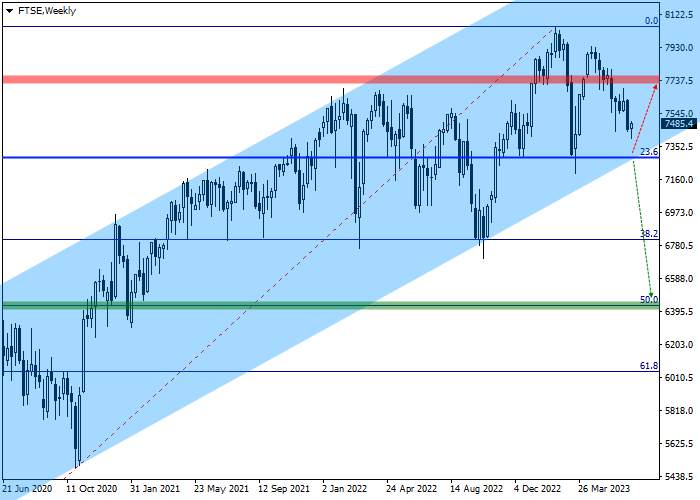
We present a mid-term investment review of the FTSE 100 index.
Since the beginning of April, stock indicators have been under pressure and are somewhat retreating from their peak values, nevertheless, the probability of updating the annual maximum is high. The situation with the FTSE 100 index of leading UK enterprises is completely different. The impact it has faced in recent months has led to a decline in quotations from 8000.0 to the current level of 7400.0, which is the most significant drop among the indices of the world's leading economies and exceeds -8.0%. The driver of the negative dynamics is the situation in the national economy of Great Britain, which is slowing down, despite the aggressive policy of raising the interest rate, which last week was brought to 5.00% for the first time since the autumn of 2008. In addition, the consumer price index in May was 8.7%, increasing from 8.4% earlier and confirming that inflation in the country remains the highest among the leading economies. At the same time, the baseline indicator, which does not take into account fuel and food prices, reached 7.1% in May, which is the highest value in the entire history of observations since 2008.
So, there are now two global pressure factors for the stock index. The first and main one is the continuation of the "hawkish" course by the Bank of England to slow down the growth rate of consumer prices to 2.0%, for which new steps will probably be taken to tighten monetary conditions, which will certainly have an impact on both businesses and households. The second negative factor is the proximity of a recession, since a long cycle of interest rate correction leads to a drop in demand for investment capital.
In addition to the underlying fundamental factors, technical indicators signal a possible downward movement in the near future: on the weekly chart, the price continues to be within the global ascending channel with dynamic boundaries of 7350.0–8950.0, falling in the direction of the support line.
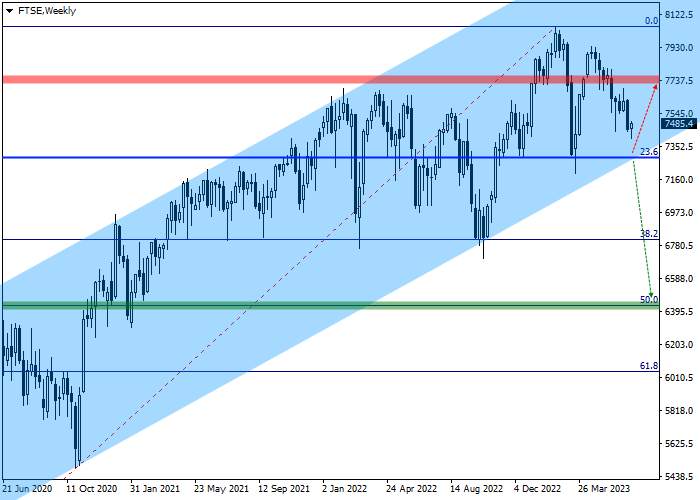
In addition, the price is approaching the level of the initial Fibonacci retracement of 23.6%, which is at around 7300.0 and is a key marker for the continuation of the decline. In general, the main factors indicate a high probability of further downward dynamics and the achievement of an intermediate Fibonacci retracement level of 50.0%.
Key levels can be seen on the daily timeframe.
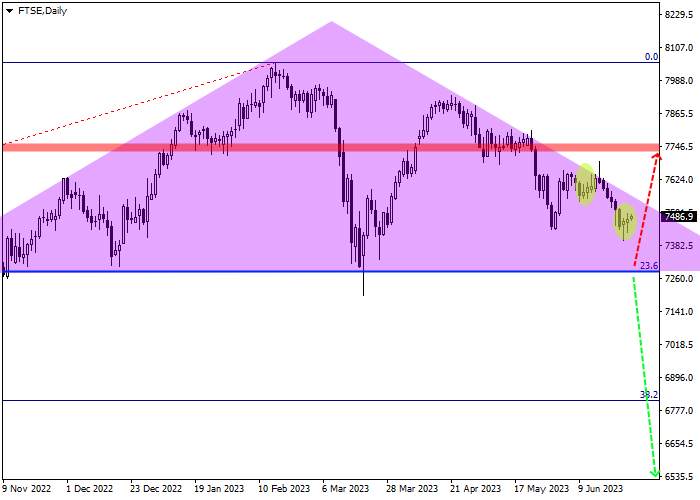
As can be seen on the chart, the price has already formed the necessary reversal formation, the point of implementation of which coincides with the level of the initial Fibonacci retracement of 23.6%. Also, in favor of a possible continuation of the decline, the re-formation of a rare Three Crows candle pattern signals, the implementation of which may begin tomorrow. A sell signal cancellation zone is located at 7740.0. In case of overcoming the local maximum of June 7 and subsequent growth, the downward scenario will either be canceled or significantly delayed in time, and open sell positions should be liquidated. In the area of the 6430.0 mark, which coincides with the level of the intermediate Fibonacci retracement of 50.0%, there is a target zone, it is in the case of reaching which it is necessary to fix the profit on open sell positions.
In more detail, the levels of entry into transactions should be evaluated on a four-hour chart.
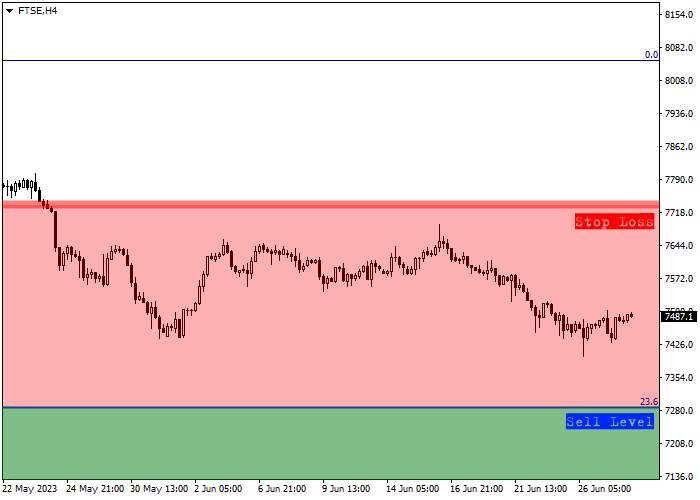
The entry level to sell deals is located at 7300.0, which coincides with the level of the initial Fibonacci retracement of 23.6%, and a local signal can be received in the coming days. Technically, a breakdown of this level will be implemented, after which there will be no significant supports left on the price's path to the target level of 6430.0, and positions can be realized.
Taking into account the average daily volatility of the trading instrument over the past month, which is 42.0 points, the price movement to the target zone of 6430.0 may take about 53 trading sessions, however, with increasing volatility in the stock index, this time may be reduced to 45 trading days
إخلاء المسؤولية: الآراء الواردة هنا تعبر فقط عن رأي الكاتب، ولا تمثل الموقف الرسمي لـ Followme. لا تتحمل Followme مسؤولية دقة أو اكتمال أو موثوقية المعلومات المُقدمة، ولا تتحمل مسؤولية أي إجراءات تُتخذ بناءً على المحتوى، ما لم يُنص على ذلك صراحةً كتابيًا.

اترك رسالتك الآن