


NCM Investment - The Festival of GOLD
OPEN ACCOUNT AND GET A CHANCE TO WIN GOLD
For more details: https://www.nooralmal.com/gold...
Official Website: https://www.nooralmal.com/
EURUSD
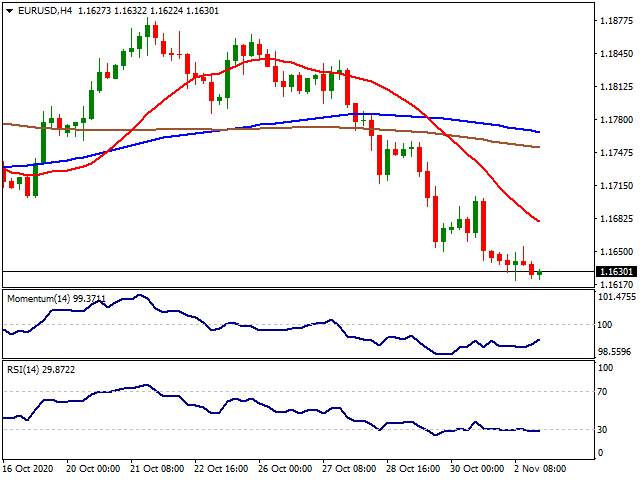
The EUR/USD pair reached a fresh multi-week low of 1.1621, despite encouraging European data. The week started with a dismal mood after more European countries announced lockdowns to curb the coronavirus contagions. Also, the looming US presidential election forces investors into the caution corner, as there are good chances that the final result of the election will be known in a few days.
Markit published the final versions of the October Manufacturing PMIs. The EU index came in at 54.8, better than the previous estimate of 54.4. The German Manufacturing PMI came in at 58.2. In the US, manufacturing output was revised from 53.3 to 53.4. The official ISM Manufacturing PMI jumped to 59.4 from 55.4 in September, providing additional support to the American currency. Better than anticipated US data helped equities to bounce although gains were limited.
This Tuesday, the European calendar has nothing to offer, and the focus will clearly be on the US presidential election, although the initial results will be out early Wednesday during the Asian session. The country will publish some minor reports, with September Factory Orders foreseen at 1% from 0.7% in August.
The EUR/USD pair remains in the bearish path, trading near the mentioned daily low. The 4-hour chart shows that technical indicators hold near oversold levels, lacking clear directional strength. The 20 SMA maintains a sharp bearish slope, now around 1.1680 and well below the larger ones. The pair could extend its decline towards the 1.1460/70 area ahead of the first-tier events scheduled for later this week.
Support levels: 1.1620 1.1575 1.1530
Resistance levels: 1.1680 1.1720 1.1770
USDJPY
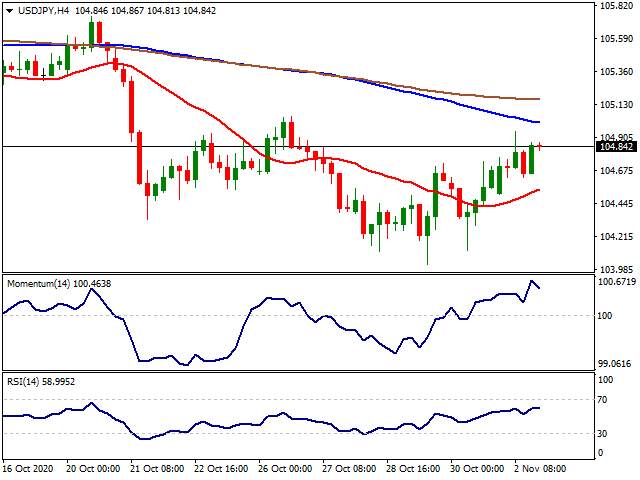
The USD/JPY pair approached the 105.00 threshold this Monday, amid persistent dollar’s demand. The American currency was supported by risk aversion at the weekly opening, later underpinned by upbeat American data. The pair stabilized in the 104.80 price zone during US trading hours, retaining gains despite election’s uncertainty sent investors into government debt, with yields giving up some ground.
Japan published at the beginning of the day the October Jibun Bank Manufacturing PMI, which resulted in 48.7, slightly better than previously estimated, although still within contraction territory. Japanese markets will be closed this Tuesday as the country celebrates Culture Day.
The short-term picture for the USD/JPY pair is mildly bullish, as, in the 4-hour chart, it is developing above a bullish 20 SMA. The larger moving averages, however, head lower above the current level. Technical indicators, in the meantime, have lost their bullish strength, but remain within positive levels. The pair would have better chances of extending its advance on a clear break above 105.05, the immediate resistance level.
Support levels: 104.30 103.95 103.50
Resistance levels: 105.05 105.40 105.85
GBPUSD
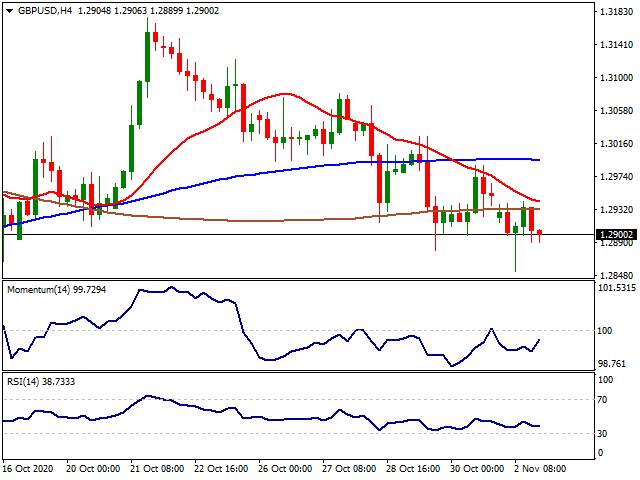
As expected, the GBP/USD pair started the week on a down note, falling to 1.2853, its lowest in almost a month. The slump came by the hand of the latest government announcement, as UK Prime Minister Boris Johnson imposed a one-month national lockdown amid resurgent coronavirus contagions. The pair surged to an intraday high of 1.2942 during London trading hours, helped by upward revisions to the Markit Manufacturing PMIs. The UK index came in at 53.7, from an initial estimate of 53.3.
The UK won’t release relevant macroeconomic data this Tuesday, with the focus on Thursday, as the Bank of England is having a monetary policy meeting and could well announce negative rates or another sort of easing. Meanwhile, Brexit talks continue in Brussels, as the UK and the EU are working to avoid a no-deal breakdown. However, there are no fresh headlines on the matter, which somehow dents investors’ confidence in a positive outcome.
The GBP/USD pair is trading around the 1.2900 level and at risk of falling further. The 4-hour chart shows that the pair remained capped by sellers aligned around the 200 SMA, while the 20 SMA maintains a strong bearish slope just above the larger one. Technical indicators in the mentioned time-frame remain within negative level with uneven directional strength but still indicating sellers overlap buyers.
Support levels: 1.2850 1.2805 1.2760
Resistance levels: 1.2950 1.2990 1.3030
AUDUSD
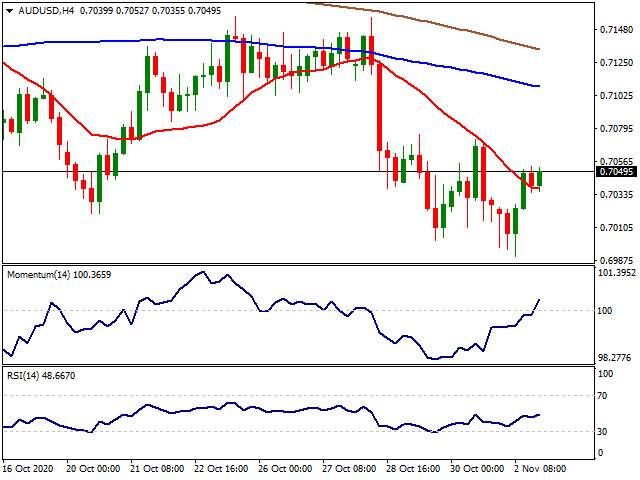
The AUD/USD pair is ending Monday with modest gains around 0.7040, recovering from a fresh multi-week low of 0.6990. The pair came under selling pressure during Asian trading hours as the sentiment was risk-averse, following weekend news indicating that more countries are taking tough restrictive measures to curb coronavirus contagions.
Australian data was mixed, as inflation fell by 0.1% MoM in October according to the TD Securities report, and resulted at 1.1% when compared to a year earlier. The October Commonwealth Bank Manufacturing PMI was confirmed at 54.2. Housing-related data showed that activity in the sector picked up in September, with Building Permits soaring 15.4%.
This Tuesday, the Reserve Bank of Australia will unveil its latest decision on monetary policy. Governor Lowe has hinted at a rate cut, and the market anticipates a cut of the cash rate to 0.1%. Analysts are also expecting an expansion of QE of up to A$100 billion.
The AUD/USD pair is neutral in the near-term, as, in the 4-hour chart it’s trading a couple of pips above a bearish 20 SMA, while below the larger moving averages, which maintain their bearish slopes. Technical indicators hover around their midlines, the Momentum advancing but the RSI flat, suggesting limited buying interest.
Support levels: 0.6990 0.6950 0.6910
Resistance levels: 0.7070 0.7110 0.7160
CRUDE WTI
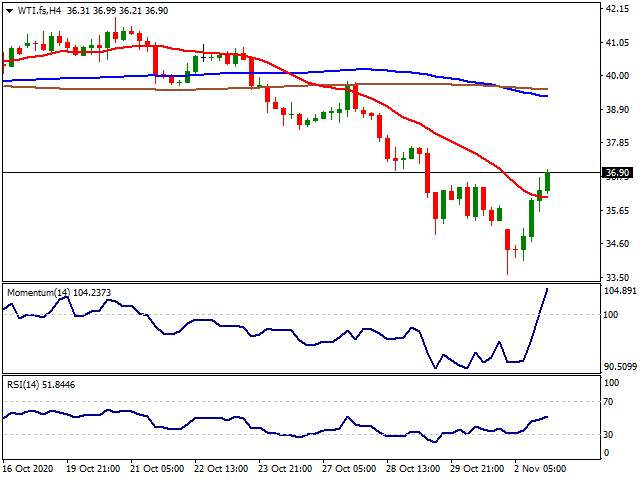
WTI had an extremely volatile trading session on Monday as demand worries caused by the second wave of the pandemic sparked risk-off trading for oil in general. Major European countries announced partial lockdowns due to the record number of new cases while the US faces almost 1,000 casualties per day. Also, oversupply concerns pressuring oil prices lately. The Organization of the Petroleum Exporting Countries' (OPEC) oil output increased by 210,000 barrels per day (BPD) in October with Libya and Iraq ramping up production, a Reuters survey showed on Friday. WTI sank to its five-month low before the buyers kicked in as OPEC+ is expected to delay their raising the output.
Technically speaking, $33.00 zone stands as the breakdown level to confirm a bear market has started. Below the $37.00, the supports can be followed at $33.23 ($0.00-$43.49 23.60%), $26.88 ($0.00-$43.49 38.20%) and $21.75 ($0.00-$43.49 50.00%). Over the $37.00 zone, resistance can be followed at $39.00, $40.00 and $42.00 zone (July-august consolidation range).
Support Levels: $33.23 $26.88 $21.75
Resistance Levels: $39.00 $40.00 $42.00
DOWJONES
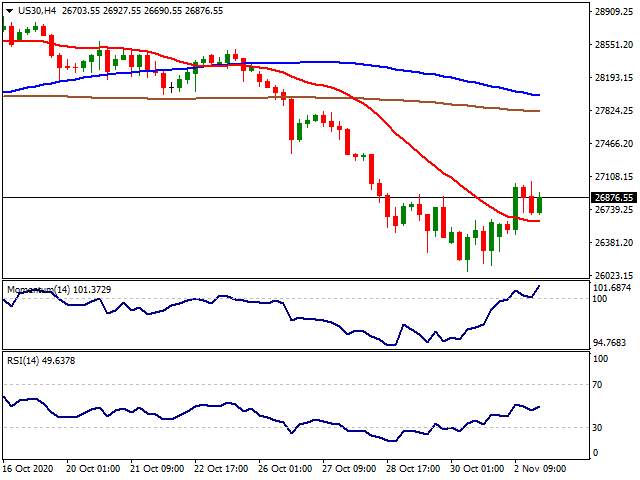
Dow Jones started the week with a bullish gap as better than expected Chinese and US PMI data readings sparked risk appetite on the markets. The business activity in the US' manufacturing sector expanded at an impressive pace in October with the ISM Manufacturing PMI jumping to 59.4 from 55.4 in September. This reading beat analysts' estimate of 55.8 by a wide margin. Also, China’s Caixin Manufacturing PMI outperformed, printing at 53.6 versus 53.0 expected. That followed solid official manufacturing and non-manufacturing PMI released over the weekend. Better than expected PMI data sets indicates the global economic activity is picking up the pace. On the other hand, the second wave of the pandemic forced European countries to re-impose partial lockdown measures while the number of new cases and casualties continues to escalate in the US. Apart from the macro data-sets and pandemic, all focus now is at the elections in the US. In case of a delay in announcing the results, markets will face serious volatility in coming days. Also, the direction of the markets will be set depending on the election results as a net Democrat win for the presidency, congress and house might pressure the USD.
If Dow Jones keeps its stance over 27,000 level decisively, 27,583 (June 2020 high), 28,000 and 28,402 levels can be followed as resistances. Below the 27,000 level, the supports can be followed at 26,000 with 25,210 (29,568-18,158 61.80%) and 24,690 (2020 April-May resistance) levels.
Support Levels: 26,000 25,210 24,690
Resistance Levels: 27,583 28,000 28,402
SILVER
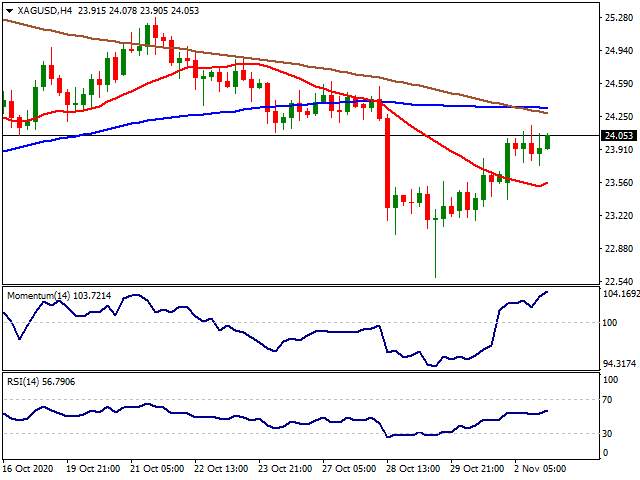
Silver also kept its positive move despite the incline seen in the USD index DXY on Monday. The USD index DXY managed to lift itself over 94.00 level and Silver outperform Gold pushing Gold to Silver ratio to sub-79.00 level. Chinese manufacturing PMI continues to improve signalling a normalisation in global economic activity is improving. Therefore, as Silver is both a true commodity and a form of money, in the long run, Silver might be a winner trade against Gold.
Below the $22.90 level ($11.63-$29.86 38.20%), the supports can be followed at $20.75 ($11.63-$29.86 50.00%) and $18.42 ($11.63-$29.86 61.80%). Over the $22.90 level, the targets up can be followed at $25.21 ($11.63-$29.86 23.60%), $26.00 (August-September support), $27.00 and $28.00 levels.
Support Levels: $22.90 $20.75 $18.42
Resistance Levels: $25.21 $26.00 $27.00
GOLD
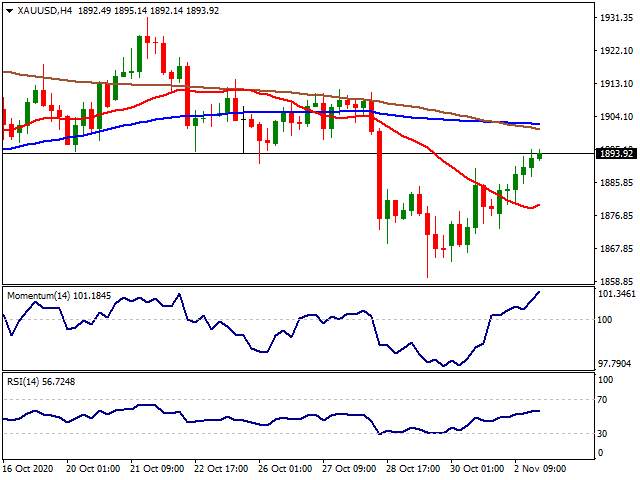
Despite the move up seen in the USD index DXY, Gold also managed to extend its positive move testing shy of $1,900. At this point, markets decided to bank on Gold as the elections might create uncertainty and usual correlations might not work in the short-term. On the other hand, usually, Gold’s reaction to big events such as elections or geo-politics disputes is short-lived. Therefore, the elections will create some volatile sessions this week until the results are cleared and depending on the outcome, USD and Gold will set a course for mid-term. The second wave of the pandemic already surpassed the first wave in terms of daily new cases forcing European countries to announce partial lockdown measures. The risk appetite is shadowed by the direction of the pandemic while global macro-data sets continue to improve indicating the correction in economic activity.
Below the $1,860 level, the supports can be followed at $1,763 ($1,451-$2,075 61.80%) and $1,700 levels. Over the $1,860 level, the resistances can be followed at $1,900 with $1,956 ($1,451-$2,075 38.20%) and $2,000 levels.
Support Levels: $1,860 $1,763 $1,700
Resistance Levels: $1,900 $1,956 $2,000
MACROECONOMIC EVENTS
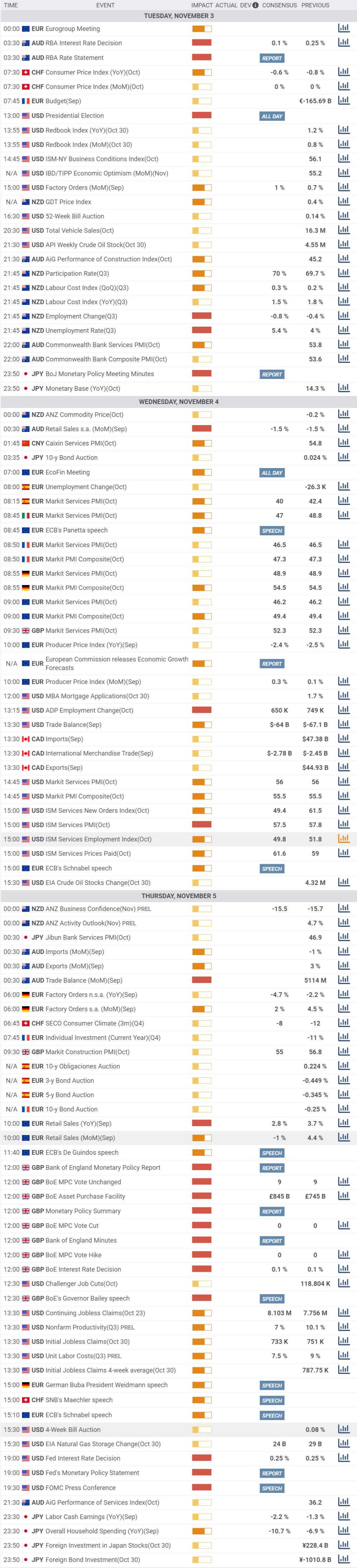
* All the Moving Average support and resistance levels are dynamic by nature. Means when the price approaches the Moving averages, slight variation occurs in the forecasted Moving Average support and resistance levels. Previous few days’ intraday levels are also signicant while trading the current day as the price tend to hover around these levels for some time. Levels in red indicate strong, critical or vital.
Please remember that trading financial markets carry a high degree of risk to your capital. It is possible to lose more than your initial stake. Leveraged products may not be suitable for all investors, therefore please ensure you fully understand the risks involved and seek independent advice if necessary.
All Rights Reserved © Noor Al Mal
إخلاء المسؤولية: الآراء الواردة هنا تعبر فقط عن رأي الكاتب، ولا تمثل الموقف الرسمي لـ Followme. لا تتحمل Followme مسؤولية دقة أو اكتمال أو موثوقية المعلومات المُقدمة، ولا تتحمل مسؤولية أي إجراءات تُتخذ بناءً على المحتوى، ما لم يُنص على ذلك صراحةً كتابيًا.

اترك رسالتك الآن