


$50 Free Margin Account Campaign:
https://www.nooralmal.com/cc19...
EURUSD
The EUR/USD pair traded as high as 1.2011, its highest since May 2018, trimming daily gains afterwards and turning negative on the day, on the back of upbeat US data. The shared currency advanced despite local macroeconomic figures failed to impress, as the EU published the preliminary estimate of August inflation, which was down to -0.2%, below the expected 0.2%. The final versions of the August Markit Manufacturing PMIs were mixed, as some countries suffered downward revisions, like Germany and Spain. Nevertheless, the EU index remained as previously estimated at 51.7.
The US final Markit Manufacturing PMI was reported at 53.1 for August, below the preliminary estimate of 53.6, although the official ISM index for the same month surprised with 56, better than the previous 54.2. This Wednesday, Germany will publish July Retail Sales, seen up 0.5% MoM, while the EU will unveil July’s PPI. As for the US, the focus will be on the ADP survey, expected to show that the private sector added 950K jobs in August, and July Factory Orders, seen up 6%.
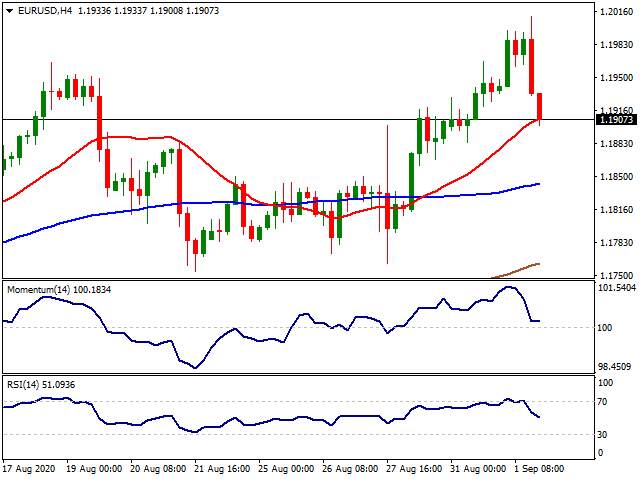
The dollar’s advance in the last trading session of the day seems corrective, exacerbated by its extreme oversold conditions. Nevertheless, it’s still the weakest across the FX board, and a sustained rally seems unlikely. The 4-hour chart for the EUR/USD pair shows that it's trading around the 1.1900 price zone, but still developing above all of its moving averages, with the 20 SMA providing support a few pips below the current level. Technical indicators, in the meantime, retreated from extreme overbought levels towards their midlines, now losing their bearish strength. The pair could extend its current decline towards 1.1820 without losing its longer-term bullish potential.
Support levels: 1.1900 1.1865 1.1820
Resistance levels: 1.1965 1.2010 1.2050
USDJPY
The USD/JPY pair trades just below the 106.00 level as the American session comes to an end, unable to advance despite the renewed dollar’s demand and the positive performance of Wall Street. Solid US economic data backed the advance of indexes and the greenback, although investors were still eager for safety. US Treasury yields remained under pressure, ending the day lower.
Japan published some encouraging figures at the beginning of the day, as the unemployment rate stayed steady at 2.9% in July against the 3.0% expected, while the August Jibun Bank Manufacturing PMI improved to 47.2 from 46.6. On a down note, Capital Spending declined 11.3% against a 4.3% advance expected. This Wednesday, the country will publish August Monetary Base, while BOJ’s Wakatabe will offer a speech.
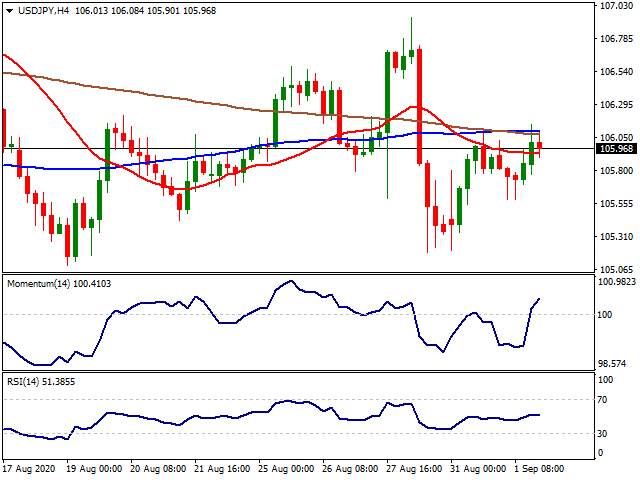
From a technical point of view, the USD/JPY pair has little chances of extending its advance. The 4-hour chart shows that the price is stuck around directionless moving averages, unable to move beyond converging 100 and 200 SMAs. The Momentum indicator advanced above its midline, but the RSI indicator is flat within neutral levels.
Support levels: 105.50 105.10 104.80
Resistance levels: 106.35 106.70 107.10
GBPUSD
The GBP/USD pair peaked at 1.3481 during European trading hours, a fresh 2020 high. The market kept selling the greenback throughout the first half of the day, underpinning the pair even as UK macroeconomic data failed to impress. According to Markit, manufacturing output in the kingdom resulted in 55.2 slightly below the previous estimate of 55.3. Mortgage Approvals in the UK surged by 66.3K in July better than expected, while Money Supply was down monthly basis.
In the Brexit front, there are no good news. UK PM Johnson’s spokesman reiterated this Tuesday that there is no possibility of extending the Brexit transition period, which ends on December 31. The UK will publish minor housing-related data this Wednesday, while BoE's Haldane and BoE's Broadbent will offer separate speeches.
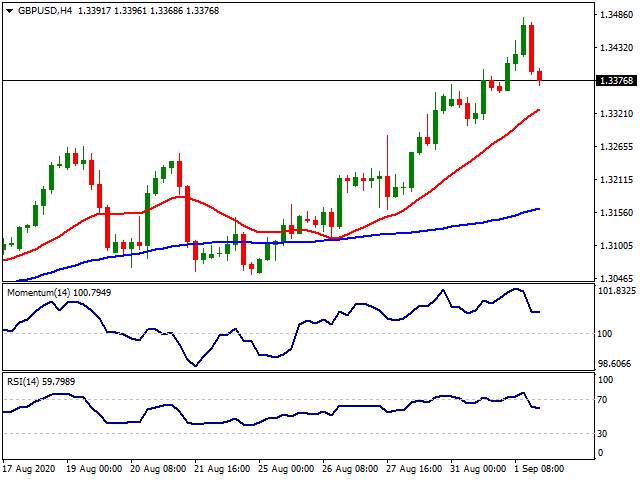
The GBP/USD pair is trading a few pips below 1.3400 retaining its bullish potential in the short-term, despite the latest slide. The 4-hour chart shows that the intraday decline stalled well above a firmly bullish 20 SMA which keeps advancing above the larger ones. Technical indicators, in the meantime, have corrected extreme overbought readings, but pared their declines well above their midlines, suggesting that some profit-taking occurred, but bears are still out of the picture.
Support levels: 1.3330 1.3295 1.3260
Resistance levels: 1.3400 1.3445 1.3490
AUDUSD
The AUD/USD pair is little changed for a second consecutive day, confined to a tight range yet near a two-year high of 0.7413. The Reserve Bank of Australia had a monetary policy meeting early Tuesday, but the event had a limited impact on the local currency. The central bank left the cash rate unchanged, and policymakers reiterated that, while the worst of the economic contraction has passed, the outlook remains “highly uncertain.” Building Permits in July rose 12% MoM while the Current Account Balance in Q2 beat expectations with 17.7B.
Renewed dollar’s demand kept the upside in check, although it fell short of taking the Aussie lower. Early Wednesday, Australia will publish its Q2 GDP. The economy is expected to have contracted 6% in the three months to June, a record slump attributed to the ongoing pandemic.
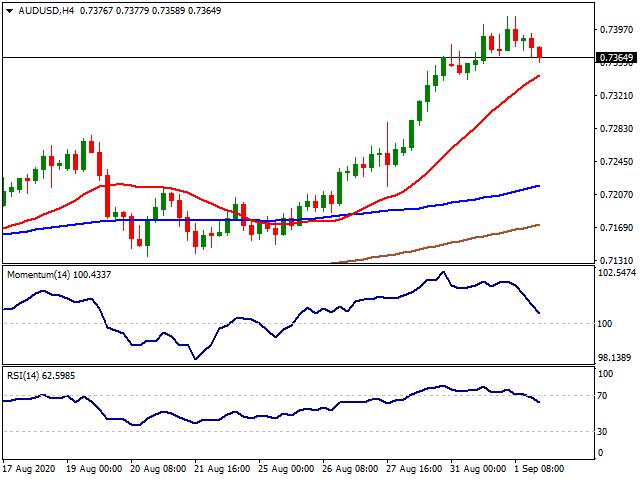
The short-term picture for the AUD/USD pair suggests that the pair may correct further lower during the upcoming sessions as it’s pressuring daily lows ahead of the close. The 4-hour chart shows that it is still developing above bullish moving averages, with the 20 SMA providing dynamic support at 0.7340. Technical indicators, in the meantime, head firmly lower, retreating from overbought readings and approaching their midlines.
Support levels: 0.7340 0.7300 0.7260
Resistance levels: 0.7400 0.7440 0.7475
SILVER
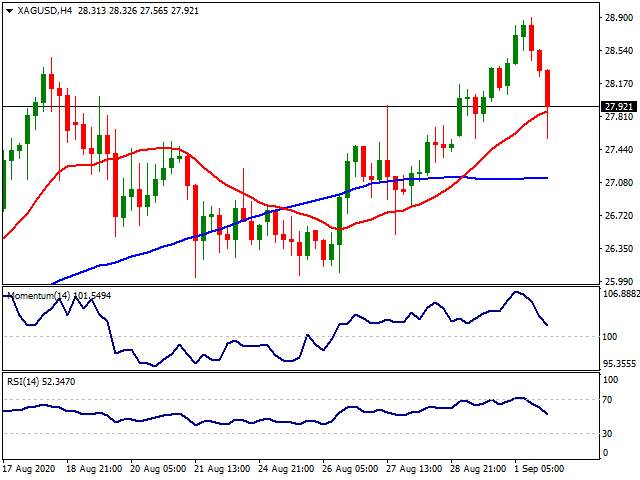
Silver failed to sustain its move over 28.00$ as better than expected US ISM data set created a reversal in the USD index DXY. Before the release of the data, the white metal was on its way to test 29.00$. However, an upbeat data set pushed Silver back below 28.00$. On the other hand, Gold to Silver ratio is holding its ground around 70.00 level indicating the better performance of Silver. On the other hand, Silver still lacks push from the industrial front. Industrial silver demand, including electrical and ethylene oxide, is now showing signs of improvement, although it is still expected to be down year-on-year. Photovoltaic demand is also set to slip this year, with all major PV markets reeling from the impact of Covid-19. The market consensus suggests solar installations will drop by around 15%.
If Silver manages to stay over 27.00$, next targets upside might be followed at 29.28$ (March 2013 resistance), 30.00$ and 32.00$ levels. Below the 27.00$ level, the supports might be followed at 25.00$ and 24.00$ levels.
Support Levels: 27.00$ 25.00$ 24.00$
Resistance Levels: 29.28$ 30.00$ 32.00$
CRUDE WTI
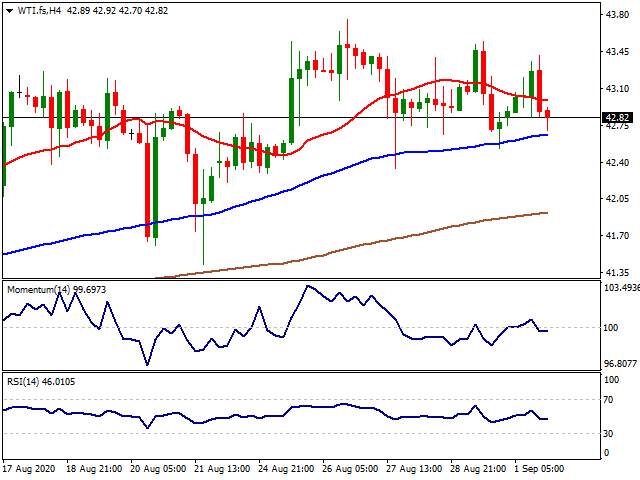
WTI also had a volatile day on Tuesday as better than expected US ISM data set lifts the USD index DXY from its lows. On the other hand, a better data set indicates a possible more demand for energy. However, OPEC’s production adjustment limited this advance as oil output has risen by around 1 million barrels per day in August. On the other hand, Goldman Sachs reported on Tuesday that they will raise the average target price for oil as they see a surge in demand in the remaining part of the year.
If WTI manages to hold over 42.00$, next targets upside can be followed at 44.00$ (February 2020 low), 48.64$ (March 2020 high) and 50.00$. Below the 42.00$ level, supports can be followed at 41.00$ and 40.00$ consolidation zone.
Support Levels: 42.00$ 41.00$ 40.00$
Resistance Levels: 44.00$ 48.64$ 50.00$
DOW JONES
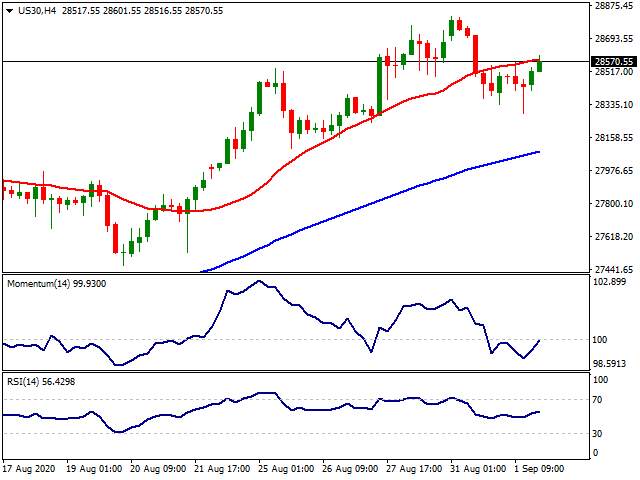
Dow Jones tried to re-gain its lost ground on Monday trading with the help of a better than expected US ISM data set. The manufacturing sector in the US is robust, and the Tuesday report from the Institute of Supply Management showed a stronger than expected number. The August ISM Manufacturing Index came in at 56.0 in August compared to expectations that it would rise to 54.5 from 54.2 in July. New orders surged to 67.6 in August from 61.5 in July and production rose to 63.3 in August from 62.1 in July. Backlogs also increased to 54.6 from 51.8 in July, while prices paid jumped to 59.5 from 53.2. The August expansion in manufacturing was the 4th consecutive month of expansion in a row. On the other hand, the deadlock continues still about the second stimulus programme as White House gears up for the upcoming elections. Despite the improvement seen in manufacturing data, labour data set is set to contradict in the coming period. Compared to S&P and Nasdaq, Dow Jones underperforms as the index is still away from it's all-time high.
From the technical point of view, over the physiological 28.000 level, 28.400 can be followed as next resistance while below 27.770 level the supports can be seen at 27.400, 27.000 and 26.757 (24.680-27.400 %23.60) levels.
Support Levels: 27.700 27.400 27.000
Resistance Levels: 28.400 29.000 29.500
GODLDLLDLD
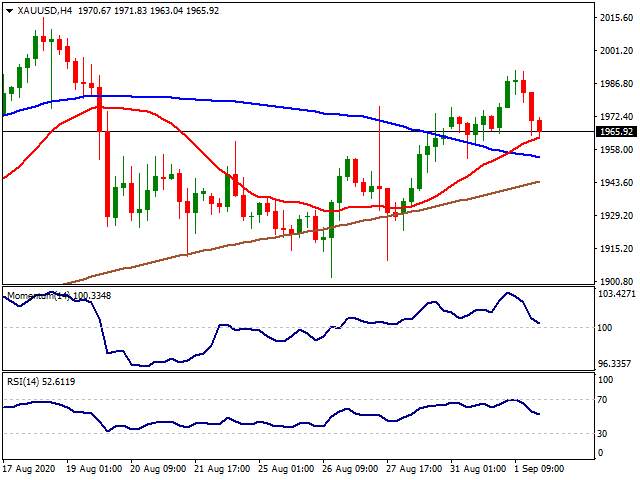
Gold had a sharp reversal on Tuesday failing to test 2.000$ barrier as a better than expected US PMI data set lifted USD from its fresh two year lows. The USD index DXY slid below the 92.00 level to 91.75 and as a result, Gold lifted to 1.992$. In its closely-watched report, the Institute for Supply Management (ISM) revealed that the economic activity in the US' manufacturing sector in August expanded at its strongest pace since January 2019. The ISM Manufacturing PMI climbed to 56 and beat the market expectation of 54.5. Additionally, the Markit Manufacturing PMI improved from 50.9 in July to 53.1. in August. Positive data set pushed the USD index back above the 92.00 level and Gold lost around 30$ on a daily basis. Despite today’s sharp reversal, Gold has still room to advance in the long run as current monetary policies are in favour of precious metals.
As long as Gold stays over 1.950$, the targets upside can be followed at 1.980$ (previous all-time high), 2.000$ and 2.040$ levels. Below the 1.950$ the supports can be followed at 1.920$, 1.900$ and 1.825$ (2011 August close) levels.
Support Levels: 1.920$ 1.900$ 1.825$
Resistance Levels: 1.980$ 2.000$ 2.040$
MACROECONOMIC EVENTS
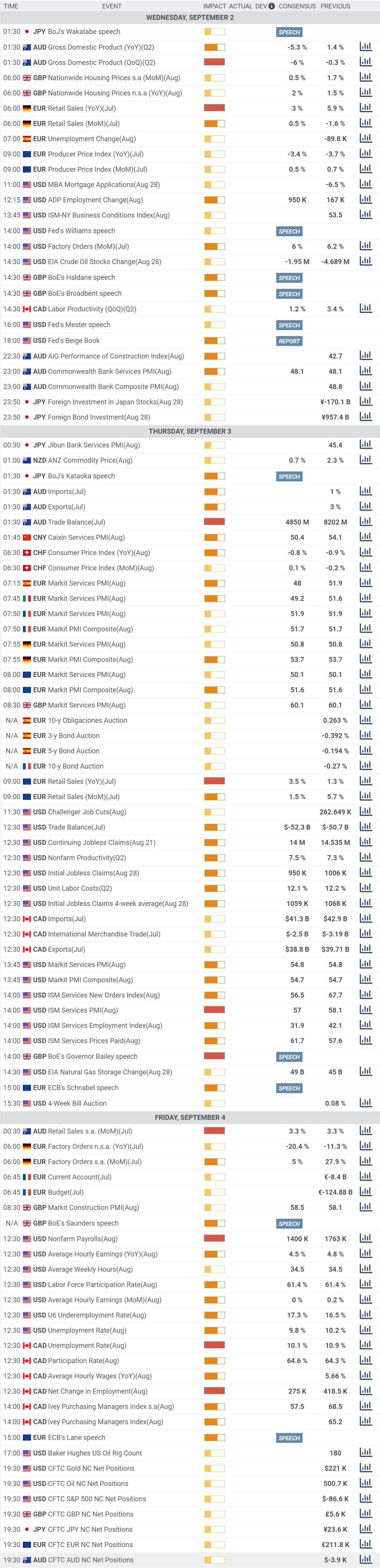
* All the Moving Average support and resistance levels are dynamic by nature. Means when the price approaches the Moving averages, slight variation occurs in the forecasted Moving Average support and resistance levels. Previous few days’ intraday levels are also signicant while trading the current day as the price tend to hover around these levels for some time. Levels in red indicate strong, critical or vital.
Please remember that trading financial markets carry a high degree of risk to your capital. It is possible to lose more than your initial stake. Leveraged products may not be suitable for all investors, therefore please ensure you fully understand the risks involved and seek independent advice if necessary.
All Rights Reserved © Noor Al Mal
#8月非农仍会延续反弹吗##全球央行年会##黄金涨不动了吗##20%涨跌幅创业板来了##2020年美国大选#
إخلاء المسؤولية: الآراء الواردة هنا تعبر فقط عن رأي الكاتب، ولا تمثل الموقف الرسمي لـ Followme. لا تتحمل Followme مسؤولية دقة أو اكتمال أو موثوقية المعلومات المُقدمة، ولا تتحمل مسؤولية أي إجراءات تُتخذ بناءً على المحتوى، ما لم يُنص على ذلك صراحةً كتابيًا.

اترك رسالتك الآن