

The market is not your enemy. Got $500? Maybe you just buy a few shares of a company you know and make investing a few bucks a month in those companies like putting money into a savings account. Yes, it goes down. No, you won’t lose it all. You can program stop losses. Any online brokerage firm can teach you how.
The Fed is telling you to buy stocks. Listen to them. Trust me on this one.
You don’t need millions, though if you had millions, a 5% gain would go along way. Most of us riff-raff don’t have that kind of money, so you are in the club! (I literally put a measly $500 in Tata Motors of India when it was trading at around $5. I made more than I would have in savings.)
Still, Paul Krugman is very sad about this. When Joe Biden wins, he will be happy once more. Here he is moaning and groaning again in The New York Times NYT.
Global stocks are being buoyed today by news that the Fed - the world’s de facto central bank – will buy individual corporate bonds in addition to the exchange-traded funds it is already purchasing, to support the world’s largest economy. This is like the Bank of Japan. This is savings protection, with risks, but not as risky as it used to be.
“This extra stimulus acts as a ‘backstop’ or ‘floor’ for equities,” says Nigel Green, CEO of the deVere Group, a financial advisory with offices globally.
“The additional Fed support was widely expected by the markets and investors who have been paying attention have been topping-up their investment portfolios recently as entry points will inevitably continue to go higher as we move forward,” he says.
Investors will use down days to buy, providing those down days are not too scary. That’s when investors tend to wait and see if it is the start of a trend rather than putting money to work.
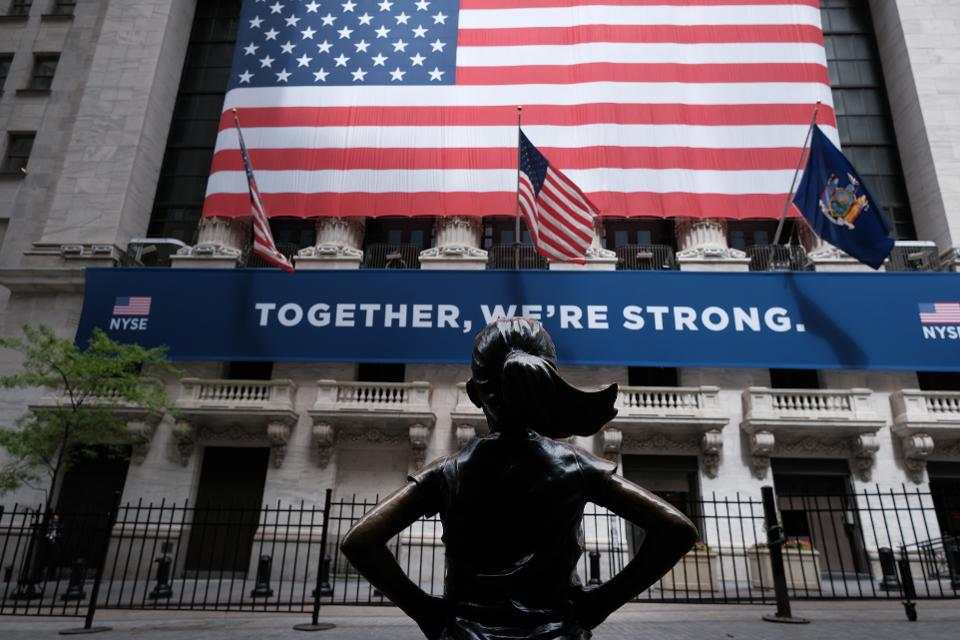
The economic recovery is not likely to lift all companies and sectors, regardless of Fed actions.
But, the massive amounts of near-zero-yielding cash savings sitting in bank accounts doing nothing, coupled with rock bottom Treasury yields should be supportive of taking on risk, especially for medium to longer-term investors. This is also true for the bond market.
“At the end of the day, we’ve seen an impressive rally and uncertainty remains, but the backdrop has modestly improved,” says Michael Fredericks, head of income investing for BlackRock BLK’s Multi-Asset Strategies Team and fund manager for the BlackRock Multi-Asset Income Fund (BIICX). “We are more comfortable incrementally adding risk,” he says.
Last week saw a return of volatility, with markets falling over a thousand points on Thursday, only to recover most of it by Friday. Equity futures were down on Monday morning, only rise by mid day on word that the Fed was going to be even more active in the markets.
Some investors wonder how all of this central bank intervention impacts price discovery on stocks. It’s hard to know.
“The timing of the Fed’s moves will be viewed as somewhat suspect, given that it comes just as the Vix spikes and equities take a dive, but the reality is that activist central banks are a feature, not a bug, and will remain the driving force for markets thanks to the boost to liquidity and confidence they provide,” says Chris Beauchamp, chief market analyst at IG.
“The mantra ‘do not fight the Fed’ is as powerful as it ever was,” Beauchamp says.
Economic activity remains weak, but there is some evidence in the high frequency data that suggests the worst may be behind us, despite a slow and troublesome plateauing of coronavirus cases in the U.S. and in important markets around the world like Brazil and Mexico.
In the U.S., modest improvements across consumer, employment and manufacturing data are promising and expected to continue this month. No one expects more lockdowns.
Market consensus expects the recovery process to be gradual with fits and starts along the way. The stock market might look like a V-shaped recovery, but the physical economy and labor markets will not mimic the S&P 500.
Risks to the recovery include a return of the new SARS virus in January and deteriorating U.S.- China relations.
On the home front, there is some talk that President Donald Trump’s administration is preparing to unveil a $1 trillion infrastructure package that would be akin to a “New Deal” as labor claws its way out of the pandemic.
Much of this depends on the House Democrats, so Wall Street is unlikely to buy too much into Trump’s infrastructure bill, even though it is something many Democrats would like. They may not like to give it to Trump in an election year and could take the issue up in the winter should Biden win and the Democrats keep the House.
The U.S. economy will still be in recovery mode n 2021.
Fed Chairman Jerome Powell will speak to congress this week. Powell has a penchant for sending markets lower during his remarks, so today’s rally might not last the week.
The trend is your friend.
“Savvy investors will continue to enhance portfolios as Fed backing is likely to be maintained for years, not quarters,” says Green.
Reprinted from Forbes. All copyrights are reserved by the original author.
إخلاء المسؤولية: الآراء الواردة هنا تعبر فقط عن رأي الكاتب، ولا تمثل الموقف الرسمي لـ Followme. لا تتحمل Followme مسؤولية دقة أو اكتمال أو موثوقية المعلومات المُقدمة، ولا تتحمل مسؤولية أي إجراءات تُتخذ بناءً على المحتوى، ما لم يُنص على ذلك صراحةً كتابيًا.

اترك رسالتك الآن