



Topic & Main content
- What Is West Texas Intermediate (WTI)?
- Understanding West Texas Intermediate (WTI)
- OPEC VS the US: Who Controls Oil Prices?
TABLE OF CONTENTS:
- Who Controls Oil Prices?
- United States
- OPEC
- OPEC vs. the United States—The Future
- Five Steps to Making a Profit in Crude Oil Trading:
TABLE OF CONTENTS:
- Learn What Moves Crude Oil
- Choose Between Brent and WTI
- Read the Long-Term Chart
- Pick Your Venue
- The Bottom Line
- Crude Oil Price Forecast: 2020, 2021
- How can I made only WTI tread 2 million USD last Nine Years?
What is West Texas Intermediate (WTI)?
West Texas Intermediate (WTI) crude oil is a specific grade of crude oil and one of the main three benchmarks in oil pricing, along with Brent and Dubai Crude. WTI is known as a light sweet oil because it contains 0.24% sulfur, making it "sweet," and has a low density, making it "light." It is the underlying commodity of the New York Mercantile Exchange's (NYMEX) oil futures contract and is considered high-quality oil that is easily refined.
KEY TAKEAWAYS
- West Texas Intermediate (WTI) is a crude oil that serves as one of the main global oil benchmarks.
- It is sourced primarily from Texas and is one of the highest quality oils in the world, which is easy to refine.
- WTI is the underlying commodity for the NYMEX's oil futures contract.
- WTI is often compared to Brent crude, which is the oil benchmark for two-thirds of the world's oil contracts.
Understanding West Texas Intermediate (WTI)
WTI is the main oil benchmark for North America as it is sourced from the United States, primarily from the Permian Basin. The oil comes mainly from Texas. It then travels through pipelines where it is refined in the Midwest and the Gulf of Mexico. The main delivery and price settlement point for WTI is Cushing, Oklahoma.
The Cushing delivery system consists of 24 pipelines and 15 storage terminals. The hub has 90 million barrels of storage capacity and accounts for 13% of U.S. oil storage. The inbound and outbound capacity is 6.5 million barrels a day. Cushing is known as "The Pipeline Crossroads of the World.
OPEC vs the US: Who Controls Oil Prices?
TABLE OF CONTENTS
- Who Controls Oil Prices?
- United States
- OPEC
- OPEC vs. the United States—The Future
Who Controls Oil Prices?
Up until the middle of the 20th century, the United States of America (U.S.A) was the largest producer of oil and controlled oil prices. In the years to follow, OPEC controlled the oil markets and prices for most of the latter part of the 20th century. However, with the discovery of shale oil in the U.S.A and advances in drilling techniques, America has re-emerged as a top producer of oil. In this article, we explore the historical battle between OPEC and the United States of America to control oil prices and how world events have influenced that struggle.
KEY TAKEAWAYS
- As of 2019, OPEC controlled roughly 75% of the world's total crude oil reserves and produced 42% of the world's total crude oil output.
- However, the U.S. was the world's largest oil-producing country in 2019 with more than 12 million barrels per day.
- Although OPEC still has the ability to drive prices, the U.S. has limited the cartel's pricing power by ramping up production whenever OPEC cuts its output.
United States
Oil was first commercially extracted and put to use in the United States of America. Consequently, pricing power for the fossil fuel lay with the U.S.A which was, at that time, the largest producer of oil in the world. In general, oil prices were volatile and high during the early years because economies of scale during extraction and refining (which mark the current extraction and drilling processes) were not present. 1 For example, in the early 1860s, according to the Business Insider, the price per barrel of oil reached a peak of US $120 in today's terms, partly due to rising demand resulting from the U.S. civil war. The price fell by more than 60% over the next five years and rose by 50% during the next five years.
In 1901, the discovery of the Spindle top refinery in eastern Texas opened the floodgates of oil in the U.S. economy. It’s estimated that 1,500 oil companies were chartered within a year of the discovery. Increased supply and the introduction of specialized pipelines helped further reduce the price of oil. The supply and demand for oil rose additionally with the discovery of oil in Persia (present-day Iran) in 1908 and Saudi Arabia during the 1930s.
By the mid-twentieth century, the use of oil in weaponry and the subsequent European coal shortage further ratcheted demand for oil, and prices came crashing down to $40 in today's terms. American reliance on imported oil began during the Vietnam War and the economic boom period of the 1950s and 1960s. In turn, this provided Arab countries and OPEC, which had been formed in 1960, with increased leverage to influence oil prices.
OPEC
OPEC, or the Organization of the Petroleum Exporting Countries, was formed to negotiate matters concerning oil prices and production. As of April 2020, OPEC countries included the following 13 nations:
- Algeria
- Angola
- Congo
- Equatorial Guinea
- Gabon
- Iran
- Iraq
- Kuwait
- Libya
- Nigeria
- Saudi Arabia
- United Arab Emirates
- Venezuela
The 1973 oil shock swung the pendulum in OPEC's favor. That year, in response to America's support for Israel during the Yom Kippur War, OPEC and Iran stopped oil supplies to the United States. The crisis had far-reaching effects on oil prices.
OPEC controls oil prices through its pricing-over-volume strategy. According to Foreign Affairs magazine, the oil embargo shifted the structure of the oil market from a buyer's to a seller's market. In the magazine's view, the oil market was earlier controlled by the Seven Sisters, or seven western oil companies, that operated a majority of the oil fields. Post-1973, however, the balance of power shifted towards the countries that comprise OPEC. According to them, “what the Americans import from the Persian Gulf is not so much the actual black liquid but its price.
A number of world events have helped OPEC maintain control over oil prices. The fall of the Soviet Union in 1991 and the resulting economic tumult disrupted Russia's production for several years. The Asian financial crisis, which had several currency devaluations, had the opposite effect in that it reduced oil demand. In both instances, OPEC maintained a constant rate of oil production. As of 2019, OPEC controlled 74.9% of the world's total crude oil reserves and produced 42% of the world's total crude oil output.
OPEC+ came into existence in late 2016 as a means for the top oil exporting nations to exert control over the price of the precious commodity. Essentially, OPEC+ is an amalgamation of OPEC and high oil exporting non-OPEC nations like Russia and Kazakhstan. Combined, they control over 50 percent of global oil supplies and about 90 percent of proven oil reserves. OPEC+ remains influential due to three primary factors:
- An absence of alternative sources equivalent to its dominant position
- A lack of economically feasible alternatives to crude oil in the energy sector
- OPEC, especially Saudi Arabia, has the world's lowest barrel production costs.
These advantages enable OPEC+ to have a wide-ranging influence over oil prices. Thus, when there is a glut of oil in the world, OPEC+ cuts back on its production quotas. When there is less oil, it increases oil prices to maintain stable levels of production.
In the spring of 2020, oil prices collapsed amid the COVID-19 pandemic and economic slowdown. OPEC and its allies agreed to historic production cuts to stabilize prices, but they dropped to 20-year lows.
OPEC vs. the United States—the Future
But OPEC's monopoly over oil prices seems to be in danger of slipping. The discovery of shale oil in North America has helped the U.S.A achieve near-record volumes of oil production. According to the Energy Information Administration (EIA), America's oil production was 12 million barrels per day (bpd) in 2019, making them the world's largest oil-producing country. As of December 2019, U.S.A. was the world's top producer followed by Russia and Saudi Arabia. However, Saudi Arabia is still the global leader in exporting oil followed by Russia and Iraq. In fact, these three nations, all members of OPEC+, account for nearly 36% of the supply of oil for the rest of the world.
Shale is also gaining popularity beyond American shores. For example, China and Argentina have drilled more than 475 shale wells between them in the last few years. Other countries, such as Poland, Algeria, Australia, and Colombia, are also exploring shale formations. A viable alternative to OPEC+ could shift the power structure.
The Iran-U.S. nuclear debate could also impact oil production and supply in the future as further discord could provoke more sanctions to curtail production which would affect prices. Other factors that impact the price of oil include the budgets of Arab nations, which need high oil prices to fund government spending programs. Also, demand continues to increase from developing economies, such as China and India, further influencing prices in the face of constant production.
The dynamics of the oil economy are complex, and the oil price determination process goes beyond the simple market rules of demand and supply, though at its most primal level the market is the final arbiter of the price of oil. Theoretically, oil prices should be a function of supply and demand. When supply and demand increase, prices should drop and vice versa. But the reality is often quite different. Oil's status as the preferred source of energy has complicated its pricing. Demand and supply are only part of the complex equation that has generous elements of geopolitics and environmental concerns.
Regions that hold pricing power over oil control vital levers of the world's economy. The United States controlled oil prices for a majority of the previous century, only to cede it to the OPEC countries in the 1970s. Recent events, however, have helped to shift some of the pricing power back towards the United States and western oil companies, which led OPEC to form an alliance with Russia et al. to form OPEC+.
As oil prices rise, U.S. oil companies pump out more oil to capture higher profits which would limit OPEC's ability to influence the price of oil. Historically, OPEC's production cuts had devastating effects on global economies which has been somewhat diminished recently. Also, the U.S. is one of the world's top consumers of oil, and as production at home increases, there will be less demand for OPEC oil in the U.S.
But, it is important to note that, although the United States is the top producing nation, the top exporters are predominantly members of OPEC+, which means that they are still the key player in the oil price determination process.
There may come a day when OPEC loses its clout but that day is not yet here.
Five Steps to Making a Profit in Crude Oil Trading:
TABLE OF CONTENTS
- Learn What Moves Crude Oil
- Choose Between Brent and WTI
- Read the Long-Term Chart
- Pick Your Venue
- The Bottom Line
Crude oil trading offers excellent opportunities to profit in nearly all market conditions due to its unique standing within the world’s economic and political systems. Also, energy sector volatility has risen sharply in recent years, ensuring strong trends that can produce consistent returns for short-term swing trades and long-term timing strategies.
Market participants often fail to take full advantage of crude oil fluctuations, either because they haven’t learned the unique characteristics of these markets or because they're unaware of the hidden pitfalls that can eat into earnings. In addition, not all energy-focused financial instruments are created equally, with a subset of these securities more likely to produce positive results.
KEY TAKEAWAYS
- If you want to play the oil markets, this important commodity can provide a highly liquid asset class with which to trade several strategies.
- First, decide if spot oil (and if so what grade), a derivative product like futures or options, or an exchange-trade product like an ETN or ETF are most appropriate for you.
- Then, focus on the oil market fundamentals and what drives supply, demand, and price action, as well as technical indicators gleaned from charts.
Here are five steps needed to make a consistent profit in the markets.
- Learn What Moves Crude Oil
Crude oil moves through perceptions of supply and demand, affected by worldwide output, as well as global economic prosperity. Oversupply and shrinking demand encourage traders to sell crude oil markets to lower ground while rising demand and declining or flat production encourages traders to bid crude oil to higher ground.
Tight convergence between positive elements can produce powerful up trends, like the surge of crude oil to $145.81 per barrel in July 2008, while tight convergence between negative elements can create equally powerful downtrends, like the August 2015 collapse to $37.75 per barrel Price action tends to build narrow trading ranges when crude oil reacts to mixed conditions, with sideways action often persisting for years at a time.
In the spring of 2020, oil prices collapsed amid the COVID-19 pandemic and economic slowdown. OPEC and its allies agreed to historic production cuts to stabilize prices, but they dropped to 20-year lows.
- Understand the Crowd
Professional traders and hedgers dominate the energy futures markets, with industry players taking positions to offset physical exposure while hedge funds speculate on long- and short-term direction. Retail traders and investors exert less influence here than in more emotional markets, like precious metals or high beta growth stocks.
Retail’s influence rises when crude oil trends sharply, attracting capital from small players who are drawn into these markets by front-page headlines and table-pounding talking heads. The subsequent waves of greed and fear can intensify underlying trend momentum, contributing to historic climaxes and collapses that print exceptionally high volume. (For related reading, see: Financial Markets: When Fear and Greed Take Over.)
- Choose Between Brent and WTI Crude Oil
Crude oil trades through two primary markets, West Texas Intermediate Crude and Brent Crude. WTI originates in the U.S. Permian Basin and other local sources while Brent comes from more than a dozen fields in the North Atlantic. These varieties contain different sulfur content and API gravity, with lower levels commonly called light sweet crude oil. Brent has become a better indicator of worldwide pricing in recent years, although WTI in 2017 was more heavily traded in the world futures markets (after two years of Brent volume leadership).
Pricing between these grades stayed within a narrow band for years, but that came to an end in 2010 when the two markets diverged sharply due to a rapidly changing supply versus demand environment. The rise of U.S. oil production, driven by shale and fracking technology, increased WTI output at the same time Brent drilling underwent a rapid decrease.
U.S. law dating back to the Arab oil embargo in the 1970s aggravated this division, prohibiting local oil companies from selling their inventory in overseas markets. This ban was removed in 2015.2
Many of CME Group’s New York Mercantile Exchange (NYMEX) futures contracts track the WTI benchmark, with the “CL” ticker attracting significant daily volume. The majority of futures traders can focus exclusively on this contract and its many derivatives. Exchange-traded funds (ETFs) and exchange-traded notes (ETNs) offer equity access to crude oil, but their mathematical construction generates significant limitations due to contango and backwardation.
- Read the Long-Term Chart
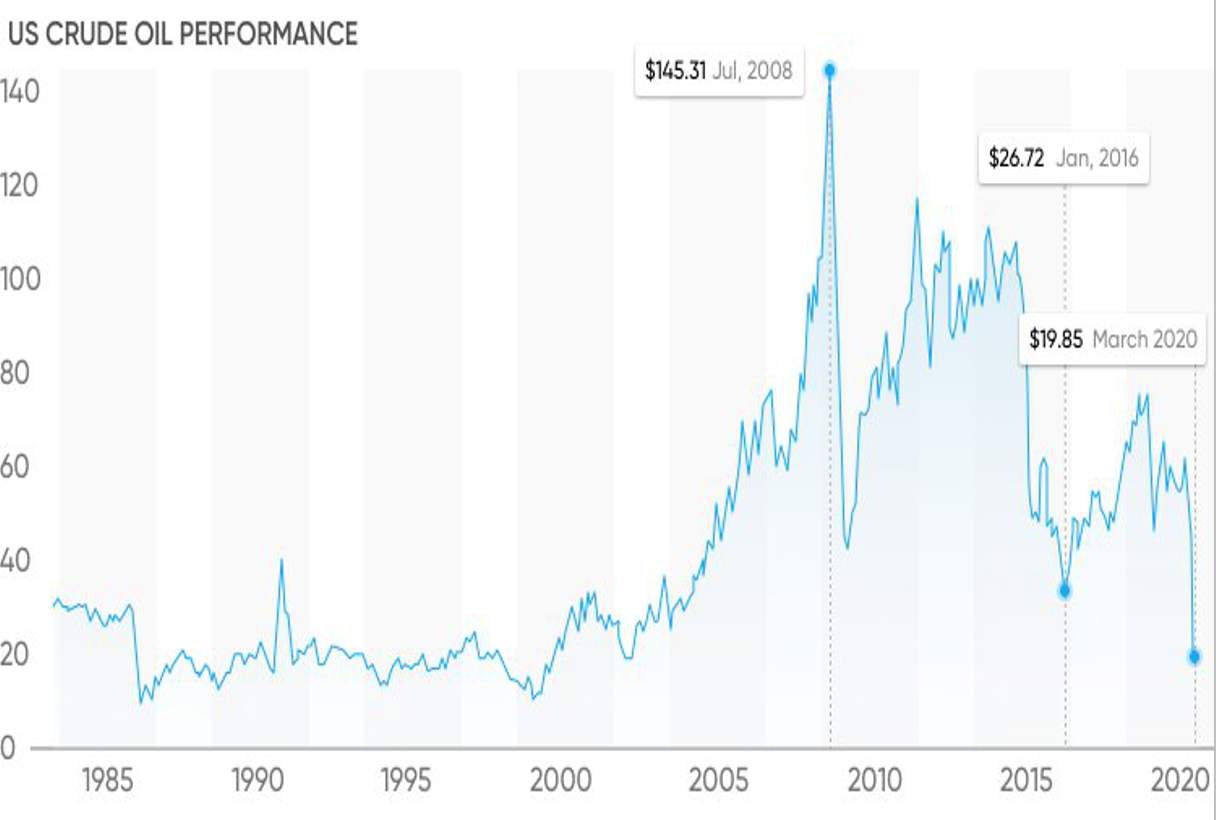
WTI crude oil rose after World War II, peaking in the upper $20s and entering a narrow band until the embargo in the 1970s triggered a parabolic rally to $120. It peaked late in the decade and began a torturous decline, dropping into the teens ahead of the new millennium. Crude oil entered a new and powerful uptrend in 1999, rising to an all-time high at $157.73 in June 2008. It then dropped into a massive trading range between that level and the upper $20s, settling around $55 at the end of 2017. As of Feb. 13, 2020, it closed at $51.52.
- Pick Your Venue
The NYMEX WTI Light Sweet Crude Oil futures contract (CL) trades in excess of 10 million contracts per month, offering superb liquidity. However, it has a relatively high risk due to the 1,000 barrel contract unit and .01 per barrel minimum price fluctuation. There are dozens of other energy-based products offered through NYMEX, with the vast majority attracting professional speculators but few private traders or investors.
The U.S. Oil Fund offers the most popular way to play crude oil through equities, posting average daily volume in excess of 20-million shares. This security tracks WTI futures but is vulnerable to contango, due to discrepancies between front month and longer-dated contracts that reduce the size of price extensions.
Oil companies and sector funds offer diverse industry exposure, with production, exploration, and oil service operations presenting different trends and opportunities. While the majority of companies track general crude oil trends, they can diverge sharply for long periods. These counter-swings often occur when equity markets are trending sharply, with rallies or selloffs triggering cross-market correlation that promotes lockstep behavior between diverse sectors.
Some of the largest U.S. oil company funds and their average daily volume as of Feb. 14, 2020, are:
- SPDR Energy Select Sector Fund: 14,959,4934
- SPDR S&P Oil and Gas Exploration and Production ETF: 29,009,1455
- VanEck Vectors Oil Services ETF: 9,882,9046
- iShares U.S. Energy ETF: 552,7197
- Vanguard Energy Index Fund ETF: 543,7338
Reserve currencies offer an excellent way to take long-term crude oil exposure, with the economies of many nations leveraged closely to their energy resources. U.S. dollar crosses with Columbian and Mexican pesos, under tickers USD/COP and USD/MXN, have been tracking crude oil for years, offering speculators highly liquid and easily scaled access to up trends and downtrends. Bearish crude oil positions require buying these crosses while bullish positions require selling them short.
- The Bottom Line
Trading in crude oil and energy markets requires exceptional skill sets to build consistent profits. Market players looking to trade crude oil futures and its numerous derivatives need to learn what moves the commodity, the nature of the prevailing crowd, the long-term price history, and physical variations between different grades.
Crude Oil Price Forecast: 2020, 2021
Brent crude oil prices will average $33.04 per barrel in 2020 and $45.62 per barrel in 2021 according to the most recent forecast from the US Energy Information Administration's (EIA) monthly Short-Term Energy Outlook. This is a decrease from an average of $64.36 per barrel in 2019 and reflects a downward revision of $3.58 per barrel for 2020 compared to the previous estimate.
International Monetary Fund, in its latest release of the World Economic Outlook, predicts a slightly less severe drop and more modest recovery with Brent oil prices to plunge to $36.9 per barrel in 2020 and then rebound to $39.5 in 2021.
Oil price forecasts depend on the interaction between supply and demand for oil on international markets. Among the most important supply-side factors weighing on pricing, expectations are US shale oil production, US crude oil stocks, and OPEC oil supply.
Below is the chronology of oil price swings since the end of the last year:
- In December 2019, Brent crude price averaged $67 per barrel, which is $10 higher than at the end of December of the previous year. This reflected the expectations that economic conditions in 2020 will be improved.
- However, in January, oil prices lost all the gain accumulated since October due to the Corona virus outbreak in China which affected oil demand due to travel restrictions and decreased entertainment spending.
- In early March, OPEC and non-OPEC partner countries failed to reach an agreement on the production cuts. As a result, the two largest oil producers - Russia and Saudi Arabia - unleashed a price war flooding market with cheap oil on the backdrop of decreasing global oil demand as Corona virus turned to pandemics. This sent oil prices down to historical lows.
- On April 12, OPEC+ countries, on their next extraordinary meeting, ultimately agreed to cut oil production by 9.7 mb/d during May and June. On the expectations of the successful deal oil prices started to rebound prior to this meeting.
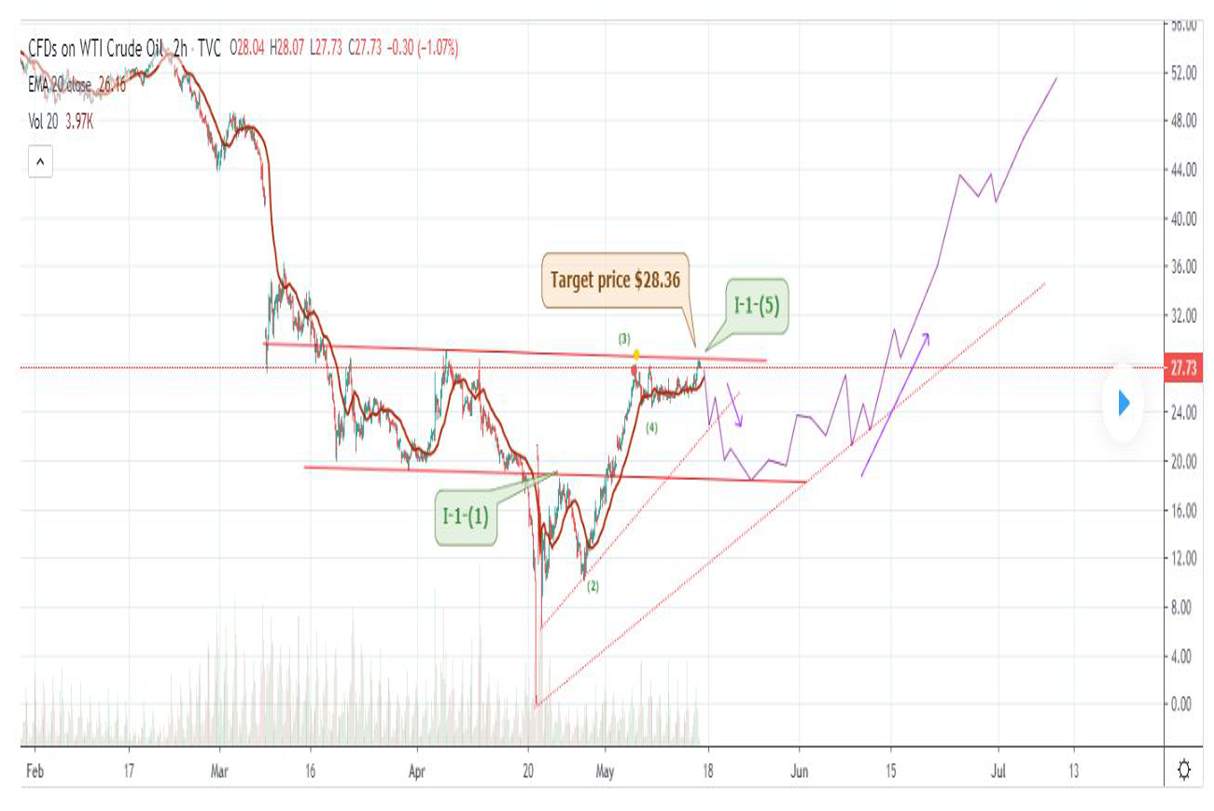
- But on April 20, prices for WTI futures that were due to expire the next day plunged below zero for the first time ever.
The reason is that because of the dramatic shrinkage of oil demand due to the lockdown measures to curb Corona virus spread, companies filled to the brim all their storage capacity with unused oil and now there is no room to put the oil. That is why they try to get rid of futures contracts that are about to come due at their cost.
Crude Oil Price prediction: 2020, 2021
إخلاء المسؤولية: الآراء الواردة هنا تعبر فقط عن رأي الكاتب، ولا تمثل الموقف الرسمي لـ Followme. لا تتحمل Followme مسؤولية دقة أو اكتمال أو موثوقية المعلومات المُقدمة، ولا تتحمل مسؤولية أي إجراءات تُتخذ بناءً على المحتوى، ما لم يُنص على ذلك صراحةً كتابيًا.

اترك رسالتك الآن