

The divergence of the RSI indicator refers to the situation when the trend of the RSI indicator's curve goes against the K-line chart. The divergence of the RSI indicator is divided into two types: peak divergence and bottom divergence.
- Peak divergence
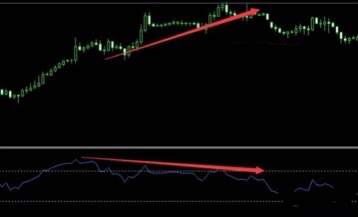
It refers to the situation when the RSI is at a high level, but the peak goes lower and lower after a record high RSI appears. At this time, the price on the K-line keeps going to new highs, leading towards a trend that has an upgoing peak. This is what is called a peak divergence. This phenomenon is generally a signal indicating the price is about to reverse from a high level, showing that the price is about to fall in the short term, in other words a sell signal.
In the actual trend, the peak divergence of the RSI means that when the price is pulling up, it first hits a high point when the RSI correspondingly hits a new high point over 80, afterwards the price falls back and the RSI falls in accordance. However, if the price rises again to a new high, and the RSI goes up as the price rises but starts to fall before surpassing its previous high, this will form a peak divergence. After the RSI diverges, it is more likely that the price will fall, which is a relatively strong sell signal.
- Bottom divergence
The bottom divergence of the RSI usually occurs in the low area below 20. When the price on the K-line chart keeps falling and forms a downward-going trend, while the RSI line took the lead in stopping and stabilizing, and formed a trend higher than the bottom, this is the bottom divergence. The bottom divergence usually indicates that the price may rebound in the short term, which is a signal of short-term buying.
In the RSI divergence, the accuracy of the top deviation is higher than that of the bottom deviation. When the price is at a high level and the RSI is above 80, it is fair to believe that the price is about to reverse downward, and the trader can short in the recent period. However, when the price is at a low level and the RSI is also at a low level, traders should be more cautious and wait for the phenomenon to repeat before confirming the trend.
Note:
The RSI is loved by many traders because of its practicality. Despite all the advantages it has, such as the ability to indicate buy or sell long before other signals, traders should be aware that RSI can also send misleading information. Due to various reasons, the indicator also has blind spots during application. In the current market, no technical analysis tool is perfect yet, and so is RSI. The indicator cannot determine the price change which is the fundamental factor that determines the operation of the indicator. The most important role of the RSI is to reflect the current market situation, for example whether the market now is strong or weak, or in a cowhide consolidation. It can also be used to roughly predict whether a peak or bottom is coming. However, RSI can only be a signal given after observing the market from a certain angle and a supplementary reference for traders, which does not mean that the market trend will necessarily develop in the direction indicated by the RSI. Therefore, traders should refer to other indicators for comprehensive analysis especially when the market is volatile, instead of simply relying on RSI signals to make buying and selling decisions.
إخلاء المسؤولية: الآراء الواردة هنا تعبر فقط عن رأي الكاتب، ولا تمثل الموقف الرسمي لـ Followme. لا تتحمل Followme مسؤولية دقة أو اكتمال أو موثوقية المعلومات المُقدمة، ولا تتحمل مسؤولية أي إجراءات تُتخذ بناءً على المحتوى، ما لم يُنص على ذلك صراحةً كتابيًا.

اترك رسالتك الآن