

What are some things that separate a good trader from a great one? Guts, instincts, intelligence and, most importantly, timing. Just as there are many types of traders, there is an equal number of different time frames that assist traders in developing their ideas and executing their strategies. At the same time, timing also helps market warriors take several things that are outside of a trader's control into account. Some of these items include position leveraging, nuances of different currency pairs, and the effects of scheduled and unscheduled news releases in the market. As a result, timing is always a major consideration when participating in the foreign exchange world, and is a crucial factor that is almost always ignored by novice traders.
Tutorial: Beginner's Guide To MetaTrader 4
Want to bring your trading skills to the next level? Read on to learn more about time frames and how to use them to your advantage.
Common Trader Time frames
In the grander scheme of things, there are plenty of names and designations that traders go by. But when taking time into consideration, traders and strategies tend to fall into three broader and more common categories: day trader, swing traderand position trader.
1. The Day Trader
Let's begin with what seems to be the most appealing of the three designations, the day trader. A day trader will, for a lack of a better definition, trade for the day. These are market participants that will usually avoid holding anything after the session close and will trade in a high-volume fashion.
On a typical day, this short-term trader will generally aim for a quick turnover rate on one or more trades, anywhere from 10- to 100-times the normal transaction size. This is in order to capture more profit from a rather small swing. As a result, traders who work in proprietary shops in this fashion will tend to use shorter time-frame charts, using one-, five-, or 15-minute periods. In addition, day traders tend to rely more on technical trading patterns and volatile pairs to make their profits. Although a long-term fundamental bias can be helpful, these professionals are looking for opportunities in the short term. (For background reading, see Would You Profit As A Day Trader? and Day Trading Strategies For Beginners.)
Figure 1
Source: FX Trek Intellicharts
One such currency pair is the British pound/Japanese yen as shown in Figure 1, above. This pair is considered to be extremely volatile, and is great for short-term traders, as average hourly ranges can be as high as 100 pips. This fact overshadows the 10- to 20-pip ranges in slower moving currency pairs like the euro/U.S. dollar or euro/British pound. (For more on pairs trading, see Common Questions About Currency Trading.)
2. Swing Trader
Taking advantage of a longer time frame, the swing trader will sometimes hold positions for a couple of hours - maybe even days or longer - in order to call a turn in the market. Unlike a day trader, the swing trader is looking to profit from an entry into the market, hoping the change in direction will help his or her position. In this respect, timing is more important in a swing trader's strategy compared to a day trader. However, both traders share the same preference for technical over fundamental analysis. A savvy swing trade will likely take place in a more liquid currency pair like the British pound/U.S. dollar. In the example below (Figure 2), notice how a swing trader would be able to capitalize on the double bottom that followed a precipitous drop in the GBP/USD currency pair. The entry would be placed on a test of support, helping the swing trader to capitalize on a shift in directional trend, netting a two-day profit of 1,400 pips. (To learn more, read The Daily Routine Of A Swing Trader and Introduction To Types Of Trading: Swing Traders.)
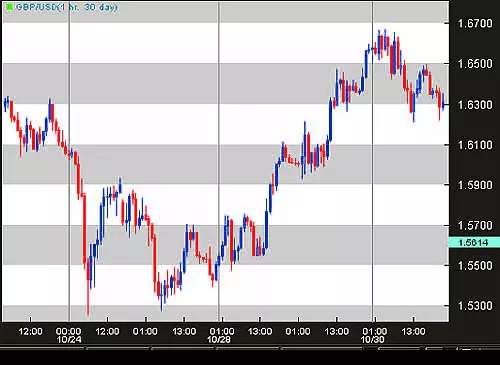
Figure 2
Source: FX Trek Intellicharts
3. The Position Trader
Usually the longest time frame of the three, the position trader differs mainly in his or her perspective of the market. Instead of monitoring short-term market movements like the day and swing style, these traders tend to look at a longer term plan. Position strategies span days, weeks, months or even years. As a result, traders will look at technical formations but will more than likely adhere strictly to longer term fundamental models and opportunities. These FX portfolio managerswill analyze and consider economic models, governmental decisions and interest rates to make trading decisions. The wide array of considerations will place the position trade in any of the major currencies that are considered liquid. This includes many of the G7 currencies as well as the emerging market favorites.
Additional Considerations
With three different categories of traders, there are also several different factors within these categories that contribute to success. Just knowing the time frame isn't enough. Every trader needs to understand some basic considerations that affect traders on an individual level.
Leverage
Widely considered a double-edged sword, leverage is a day trader's best friend. With the relatively small fluctuations that the currency market offers, a trader without leverage is like a fisherman without a fishing pole. In other words, without the proper tools, a professional is left unable to capitalize on a given opportunity. As a result, a day trader will always consider how much leverage or risk he or she is willing to take on before transacting in any trade. Similarly, a swing trader may also think about his or her risk parameters. Although their positions are sometimes meant for longer term fluctuations, in some situations, the swing trader will have to feel some pain before making any gain on a position. In the example below (Figure 3), notice how there are several points in the downtrendwhere a swing trader could have capitalized on the Australian dollar/U.S. dollar currency pair. Adding the slow stochastic oscillator, a swing strategy would have attempted to enter into the market at points surrounding each golden cross.
However, over the span of two to three days, the trader would have had to withstand some losses before the actual market turn could be called correctly. Magnify these losses with leverage and the final profit/loss would be disastrous without proper risk assessment
إخلاء المسؤولية: الآراء الواردة هنا تعبر فقط عن رأي الكاتب، ولا تمثل الموقف الرسمي لـ Followme. لا تتحمل Followme مسؤولية دقة أو اكتمال أو موثوقية المعلومات المُقدمة، ولا تتحمل مسؤولية أي إجراءات تُتخذ بناءً على المحتوى، ما لم يُنص على ذلك صراحةً كتابيًا.

اترك رسالتك الآن